Electronic Waste Transport: ADR and RENTRI Compliance
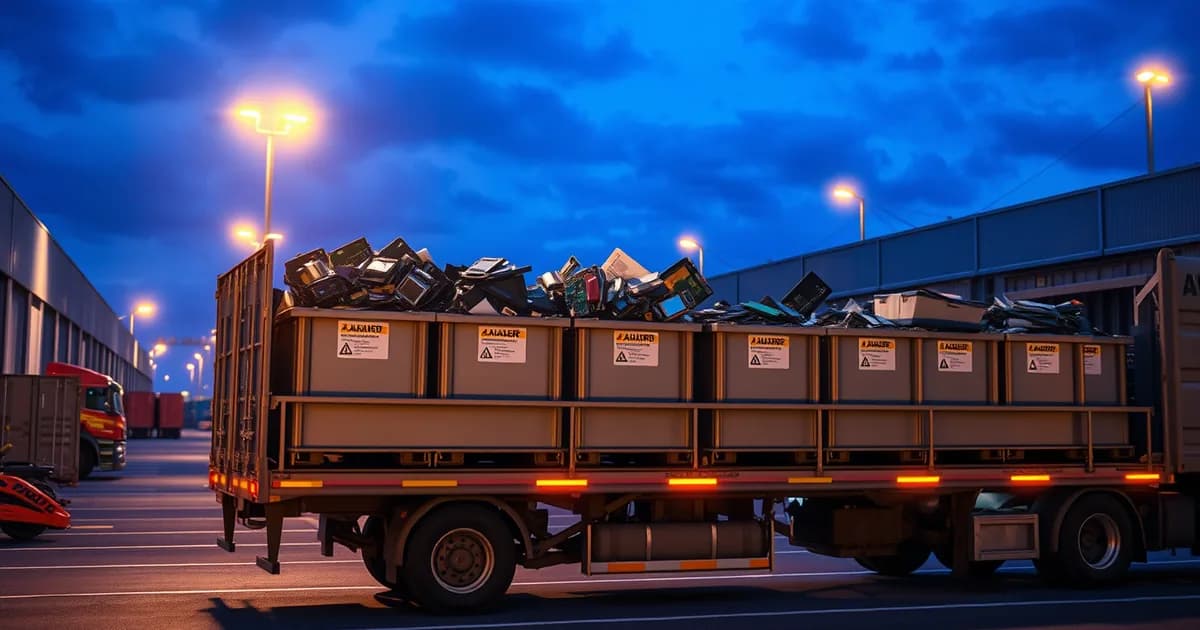
For companies managing e-waste at industrial scale, electronic waste transport is easy to underestimate. It is not a simple cargo run: it sits at the intersection of environmental law, road transport rules and, whenever batteries or hazardous components are on board, dangerous goods regulation under ADR. For industrial decision makers and sustainability managers, the exposure is twofold. On one side sit the administrative penalties set out in Italy's environmental code for irregular registration or paperwork; on the other, the operational disruption of a recovery chain that, in a fast-growing circular economy market, becomes a genuine competitive edge when it runs on traceable, compliant processes.
Electronic waste transport: the updated RENTRI framework
RENTRI, Italy's national electronic registry for waste traceability, is now the operational reference point for anyone handling electronic waste transport in the country. The staggered registration calendar, phased by company size, closed on 13 February 2026 with the last group of obligated operators; from that date, RENTRI registration is an operational prerequisite for producers, carriers and recovery plant operators. For carriers, the annual registration fee, set at 60 euros per operating unit regardless of headcount, was due by 30 April 2026. On the documentation side, the shift to the digital waste form (xFIR) as the sole accepted format was pushed back to 15 September 2026 by the conversion law of the Milleproroghe decree: until that date, the new paper form template remains valid, keeping paper and digital formats running side by side.
ADR and the lithium-battery classification issue
One technical factor increasingly complicating electronic waste transport is the growing share of lithium batteries embedded in discarded equipment, from smartphones to power tools to IoT devices. ADR rules have been updated on classification, packaging and segregation criteria for these flows, with tighter requirements whenever batteries are used, damaged or defective. A significant shift is expected from November 2026, when spent lithium batteries, currently classified under the non-hazardous waste code 160605, are set to move to a dedicated hazardous waste code, with direct consequences for packaging, labelling and staff training on handling. For recovery operators, getting ahead of this change means revisiting sorting and packing procedures for e-waste well before the transport stage itself.
Transport documents: FIR, xFIR and driver requirements
The Waste Identification Form (FIR) remains the backbone of traceability: it follows the waste from producer to receiving facility and must include, among other mandatory data, the driver's full name and the vehicle and trailer plate numbers. When a shipment falls under ADR scope, as with e-waste containing lithium batteries or other hazardous components, the FIR does not replace dangerous-goods transport documentation but must be paired with it: shipper's declaration, written instructions for the crew, and compliant onboard equipment. Drivers must hold an ADR professional training certificate specific to the hazard class being carried. As the shift to the digital form progresses, handling times change too: the countersigned copy must be returned by the receiving party within two working days of collection, while document retention, reduced from five to three years under Legislative Decree 116/2020, cuts the archiving burden compared with the previous regime.
Cross-border shipments: the new EU regulation
For companies moving e-waste across borders, the framework has tightened. Since 1 January 2025, exports of e-waste classified under codes A1181 and Y49 destined for recovery in OECD countries, as well as the corresponding imports into the EU, require prior written notification and authorisation. The new EU Waste Shipment Regulation (2024/1157) became fully applicable on 21 May 2026, replacing the previous framework with stricter control procedures for cross-border flows. For operators working with treatment facilities abroad, this means longer authorisation lead times that need to be planned well ahead in the logistics chain.
Penalties and operational continuity
The penalty risk remains the most concrete argument for investing in compliance. Under Article 258, paragraph 10, of Legislative Decree 152/2006, failure to register or irregular registration with RENTRI carries administrative fines from 500 to 2,000 euros for non-hazardous waste and from 1,000 to 3,000 euros for hazardous waste, a category that covers most e-waste streams with critical components. On top of that sits a harder-to-quantify but ultimately costlier risk: repeated non-compliance can lead to suspension of operating authorisations, with direct consequences for service continuity and relationships with industrial clients.
For companies operating along the electronics recovery chain, electronic waste transport is no longer a downstream formality but a piece that needs to be designed alongside the rest of the industrial process: correct ADR classification, up-to-date RENTRI registration, digital forms ready ahead of the September 2026 deadline, and export procedures aligned with the new EU regulation. Companies that build these requirements into their operating flows, rather than scrambling as deadlines approach, turn a regulatory obligation into a competitive advantage: less downtime, lower penalty exposure, and a documented traceability record that becomes a credibility signal for clients and international partners. In an increasingly regulated circular economy market, the ability to demonstrate compliance across the entire transport chain is set to become a selection criterion in its own right for suppliers.