Blockchain WEEE Traceability: A Guide for Industry
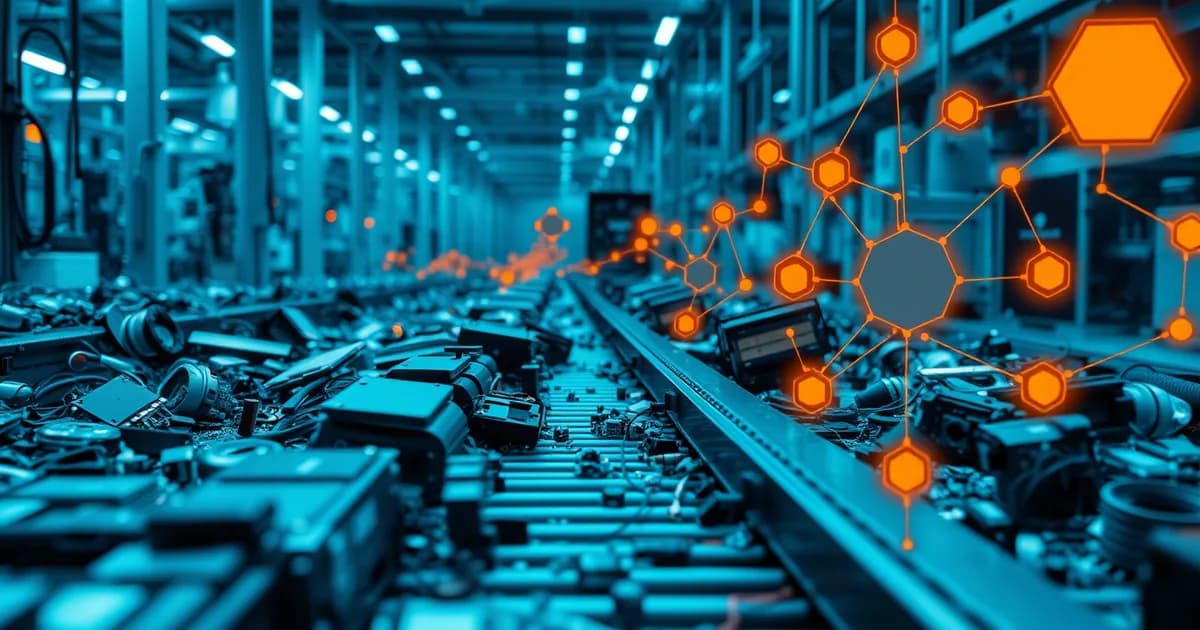
For an industrial decision maker, managing waste electrical and electronic equipment is no longer just an environmental cost line: it has become a supply chain governance issue. According to Italy's WEEE Coordination Centre, 366,891 tonnes of household WEEE were collected and sent to proper treatment last year, up 2.4% on the previous period. Inside those volumes sit critical raw materials, rare earths and precious metals of growing economic and geopolitical value. At the same time, the roll-out of Italy's national digital waste register now requires companies to prove, with data, where every load was produced, transported and treated. In this context, blockchain WEEE traceability stops being a technological experiment and becomes a concrete lever for compliance, risk reduction and competitive advantage.
Why blockchain WEEE traceability has become strategic
E-waste is among the hardest flows to control: many changes of hands, operators spread across jurisdictions, documents that historically travelled on paper. Every opaque link in the chain is a risk: administrative penalties, disputes during audits, loss of recoverable raw materials and exposure to illegal disposal. Blockchain WEEE traceability addresses exactly this, offering a shared ledger where producers, hauliers, treatment plants and supervisory authorities see the same version of the facts, without having to reconcile private, incompatible databases.
The regulatory framework pushes in the same direction. Directive 2012/19/EU (WEEE), transposed in Italy through Legislative Decree 49/2014, enshrines the principle of Extended Producer Responsibility and the obligation of traceability across the entire chain. Companies placing equipment on the market must adopt compliant, traceable and verifiable management models: technology becomes the tool that makes that verifiability automatic rather than merely paper-based.
How a distributed ledger works when applied to WEEE
Technically, a blockchain is a distributed ledger in which transactions are grouped into blocks chained together through cryptographic hash functions. Each block contains the digital fingerprint of the previous one: altering a record retroactively would mean recomputing the entire chain across all nodes, effectively making the history immutable. Applied to WEEE, this translates into the ability to assign each load a unique identifier and to record, in a tamper-evident way, chain-of-custody steps, weights, waste codes and treatment outcomes.
For a B2B industrial context the choice almost always falls on a permissioned blockchain: a controlled-access network where participants are identified and authorised, unlike public networks. This model reconciles two often competing needs: transparent sharing of supply chain data and confidentiality of commercial information. Smart contracts, that is programs executed automatically when predefined conditions occur, can validate a delivery only if the haulier is properly registered, or generate a treatment certificate the moment the plant records the outcome. This shifts control from sampled, after-the-fact checks to continuous validation embedded in the process.
Blockchain, the national register and the Digital Product Passport
Blockchain WEEE traceability does not replace legal obligations, but it can feed and reinforce them. Italy's national electronic waste traceability register, run by the Ministry of the Environment and Energy Security with the operational support of the national register of environmental operators, has completed its roll-out with the digital identification form now live. A transitional period still lets obligated operators issue the form on paper as an alternative to the digital version, but the direction is set: the chain becomes natively digital.
A corporate or consortium distributed ledger can act as an integrity-assurance layer upstream of the data that later flows into official filings, reducing the risk of tampering and misalignment. To this is added the Digital Product Passport introduced by the European ESPR ecodesign regulation, adopted in 2024, whose obligations will progressively enter into force for priority categories over the coming years, with batteries among the first sectors involved. The digital passport collects data on composition, materials and disassembly instructions: when that information is anchored to a verifiable ledger, the recycler knows in advance what it is handling and can optimise recovery.
The architecture feeding the chain: IoT, RFID and oracles
A blockchain is only as reliable as the data it receives. Real value comes from integration with field identification and sensing technologies. RFID tags and QR codes enable unique identification of products and components; IoT sensors capture weight, location and conditions during transport; in-plant vision and weighing systems certify quantities and outcomes. This data reaches the ledger through oracles, the components that connect the physical world to the on-chain one. The quality of the oracle design, and its protection, are decisive: it is the point where the cryptographic guarantee meets operational reality.
Mature platforms already exist on the market. In Europe, for instance, blockchain-based solutions for the digital material passport have been adopted by large industrial groups to trace the origin and life cycle of components. In Italy, the main collective schemes managing WEEE have deployed digital platforms that follow waste from collection to final treatment, combining identification codes and shared registers to guarantee transparency to stakeholders.
Benefits and barriers for companies
The advantages for a structured organisation are tangible: faster audits thanks to a tamper-evident control trail, lower penalty exposure, valorisation of secondary raw materials and, not least, solid data for sustainability reporting and the calculation of avoided CO2. The barriers, however, are real and must be faced clearly: the upfront costs of technology and integration, the absence of fully shared interoperability standards, and the need to make actors with different interests collaborate along the chain. Blockchain does not solve the problem of input data quality: if a delivery is measured badly, the ledger will faithfully preserve a wrong figure.
For the decision maker, the question is no longer whether to digitise traceability, but with which architecture and over which horizon. Those who build a verifiable end-to-end chain today get ahead on three fronts destined to converge: compliance with the national register and with future digital passport obligations, supply chain resilience against critical raw material scarcity, and the credibility of their ESG data. Seen this way, blockchain WEEE traceability is less a technological bet and more an investment in predictability: it turns an obligation perceived as a cost into an information asset that protects the business and tells its sustainability story with evidence.