Industrial TinyML: AI on Microcontrollers
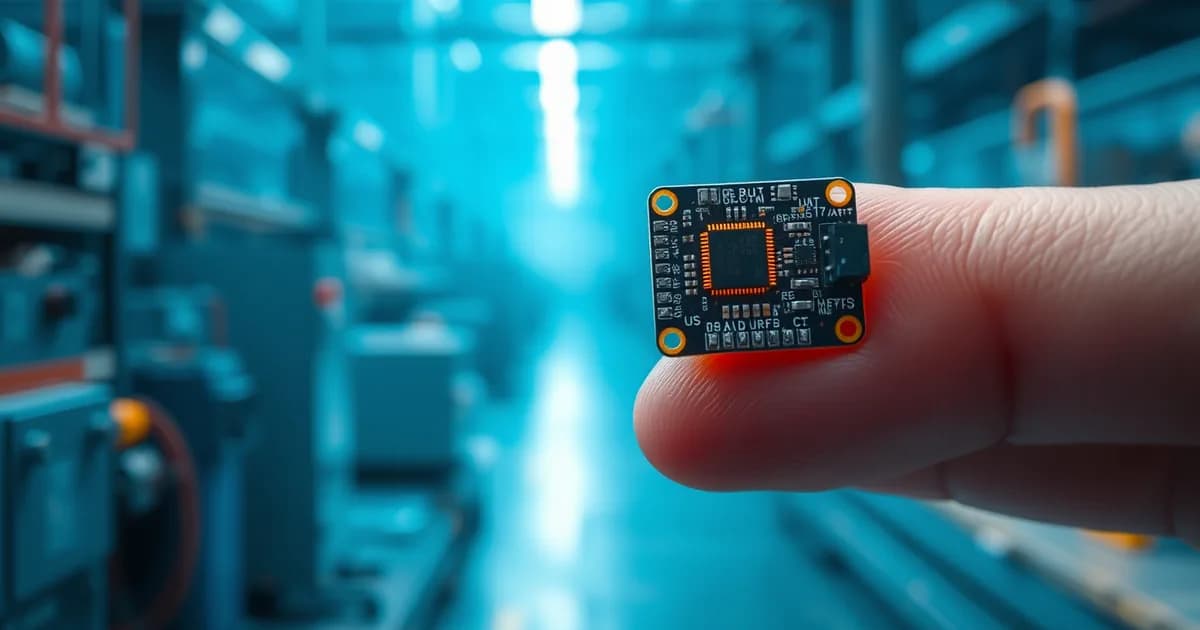
For years, industrial artificial intelligence meant dedicated servers, stable cloud connections, and rising energy bills. Today the center of gravity is shifting downward: industrial TinyML pushes machine learning inference directly onto low-cost microcontrollers running on minimal power, often below one milliwatt. For anyone managing plants, production lines, or fleets of distributed sensors, the question is no longer whether to adopt AI at the edge, but how quickly competitors are already installing it on every single node of their network. The advantage is tangible: less dependency on connectivity, near-zero decision latency, and a per-node cost that makes distributed intelligence viable even on marginal assets, where a cloud-based system's ROI could never have justified the investment before.
What industrial TinyML is and why it changes the rules of automation
TinyML is the discipline of optimizing neural networks and machine learning algorithms so they run on hardware with only tens or hundreds of kilobytes of RAM, without a complex operating system or constant network access. The stated goal of the technical community is to bring inference to ultra-low-power devices, typically consuming under one milliwatt, a threshold that allows battery power for months, or even energy harvesting from vibration and temperature differentials. Unlike edge AI on boards such as Jetson, which handles computer vision and heavier workloads, industrial TinyML runs on general-purpose microcontrollers: classifying vibration signals, recognizing acoustic patterns, or detecting anomalies in time series from temperature, pressure, or current sensors.
Frameworks and toolchains: from TensorFlow Lite Micro to Edge Impulse
The most widely used runtime for microcontroller inference remains TensorFlow Lite Micro (the evolution of TensorFlow Lite for Microcontrollers), designed for bare-metal or RTOS environments and built around a statically allocated memory arena managed deterministically, avoiding the dynamic allocations that could fragment already scarce resources. Alongside TensorFlow Lite Micro, Edge Impulse has established itself as a cloud platform covering the entire TinyML workflow: data collection and labeling, training, optimization, and firmware generation. Its EON compiler translates models into static C++ code, significantly cutting RAM usage compared with traditional interpreters, to the point of making classification models runnable even on Cortex-M0+ microcontrollers with very limited RAM. Both tools support the ARM Cortex-M processor families most common in industry, alongside boards like the ESP32, reflecting a hardware partner ecosystem that has matured across most major microcontroller vendors.
Where industrial TinyML delivers value on the factory floor
Industrial applications of TinyML cluster around four recurring areas. Predictive maintenance is the most mature: an accelerometer wired to a microcontroller analyzes a motor's or bearing's vibration signature locally, flagging abnormal drift before failure, without streaming continuous raw data to the cloud. Equipment monitoring follows a similar logic applied to compressors, pumps, and electrical panels, where real-time anomaly detection reduces unplanned downtime. In-line quality control benefits from lightweight classifiers able to catch acoustic or thermal deviations before they become confirmed defects. Finally, energy management: distributed sensors that locally optimize on/off cycles for equipment, without the latency of a centralized decision loop. Across all these cases the common thread is the same: intelligence moves from the data center to the individual node, and the network is used only for periodic consolidation of results, not for the operational decision itself.
Why TinyML beats the cloud on latency, privacy, and cost
The comparison with cloud-based inference is no longer just about energy efficiency. Processing data directly on the sensor eliminates round-trip latency to a remote server, a critical factor for safety or real-time control applications where even a few milliseconds matter. It also reduces the data exposure surface: raw information stays on the device, and only inference outputs, when needed, are transmitted, a relevant point for anyone handling sensitive production process data. On the economic side, a microcontroller capable of running TinyML inference costs roughly a fraction of a more capable edge AI module, a differential that, multiplied across hundreds or thousands of nodes distributed across a plant, meaningfully changes the overall economics of a smart-sensing project. The most recent academic research, including surveys published in 2025 on increasingly energy-efficient neural networks, confirms there is still substantial room for improvement: each new generation of quantization and model-compression frameworks further narrows the performance gap with more traditional edge AI.
The challenges worth taking seriously
Adopting industrial TinyML is not without obstacles. Models must be trained and then compressed using quantization and pruning techniques that, if applied carelessly, degrade accuracy unpredictably: this requires hybrid skills, part data scientist and part embedded engineer, which are not always available in-house within IT or maintenance teams today. Updating models in the field, so-called over-the-air (OTA) updates, also needs careful design on devices with minimal storage resources. Finally, validation: a model that classifies correctly in the lab must demonstrate the same reliability under the real-world electrical noise, vibration, and thermal swings typical of a factory environment, and this is where much of a pilot project's actual value gets tested before it can scale.
The advantage for today's decision makers
Whoever introduces distributed sensor-level intelligence first gains a competitive edge that is hard to recover later: more granular operational data, faster reaction time to failures, and a marginal cost per node that makes it possible to extend intelligent monitoring even to assets so far considered too peripheral to justify investment in traditional edge computing. Industrial TinyML does not replace more structured edge and cloud AI architectures; it complements them, pushing intelligence all the way to the last mile of the industrial network. For IT and sustainability decision makers, the practical question is no longer whether this technology is mature, but which process, among maintenance, quality, and energy, would benefit most immediately from a first industrial TinyML pilot project.