ROS 2 Edge AI: Orchestrating Industrial Robot Cells
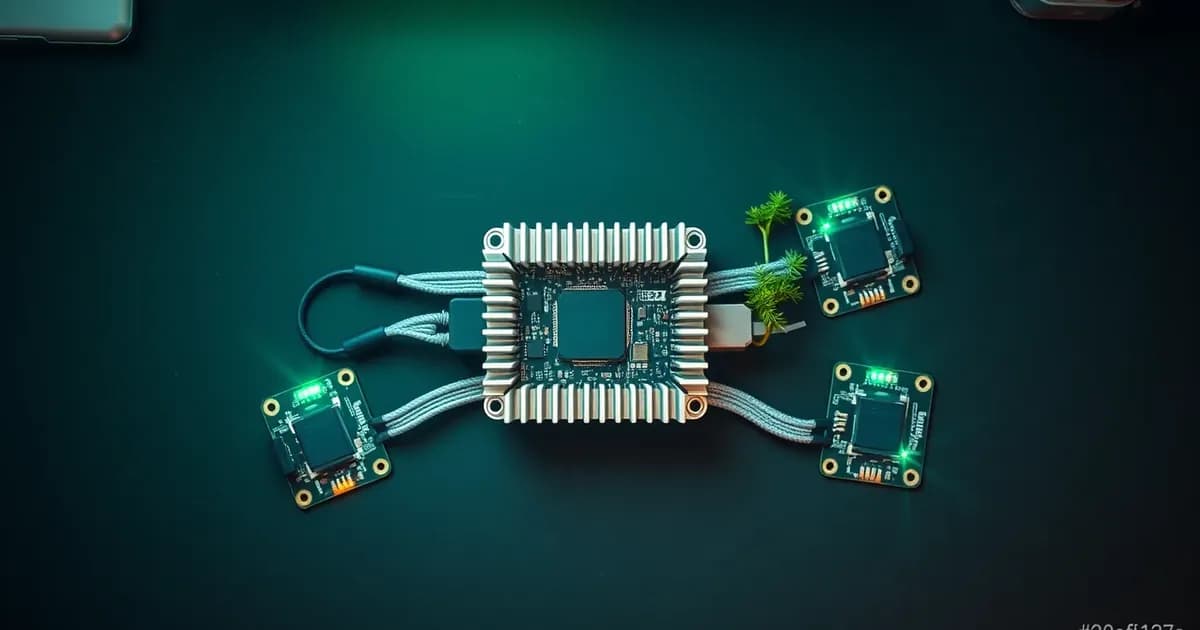
A modern robot cell is no longer a robot and its cabinet. It is a mix of cameras, arms, conveyors, force sensors and artificial intelligence models that have to talk to each other within milliseconds. As long as every supplier brings its own language and its own controller, each layout change turns into an integration project with costs and lead times that are hard to predict. This is where the ROS 2 edge AI combination changes the conversation: an open middleware that orchestrates the components, paired with a local computing platform that runs inference right next to the machine. The timing also helps planning. In May 2026 Lyrical Luth was released, the twelfth ROS 2 release and a long-term support (LTS) version maintained until May 2031. For anyone signing off an automation investment, a five-year software horizon weighs as much as the hardware data sheet.
ROS 2 edge AI: why orchestration matters more than the single robot
ROS 2 is not an operating system in the strict sense. It is a set of libraries and conventions through which the components of a cell, called nodes, exchange data over topics, services and actions. Its industrial value lies in decoupling: the node that recognises a component on a board does not need to know which arm will pick it, and the other way round. Replacing a camera or adding a second station means changing a node, not rewriting the cell.
Moving artificial intelligence to the edge completes the picture. When the vision model runs on an embedded module inside the cell, decisions do not depend on network latency or cloud availability, and production images stay on the shop floor.
Managed nodes and quality of service: a predictable cell
A robot cell cannot start up one piece at a time in random order. ROS 2 tackles this with managed nodes, which follow a defined state machine: Unconfigured, Inactive, Active and Finalized, with explicit transitions for configuring, activating, deactivating and error handling. In practice the launch system can confirm that every component has been instantiated correctly before any of them starts working, and a node can be restarted or replaced while the rest of the cell stays online.
The second pillar is communication. ROS 2 relies on the DDS standard, which exposes more than twenty Quality of Service policies: reliability, queue depth, deadlines, message durability. That flexibility comes at a price. A study published on arXiv in 2025 examined sixteen of these policies and derived 41 dependency rules whose violation commonly causes communication failures, and proposed a tool that statically checks profiles before deployment. The lesson for system designers is clear: QoS profiles should be defined and validated at the desk, not tuned by trial and error on the plant.
Lyrical Luth also adds a new executor, the Callback Group Events Executor, which according to the release notes uses 10 to 15% less CPU than the traditional executors. That headroom is welcome when the same module has to serve both control and inference.
From perception to motion: ros2_control and GPU acceleration
On the motion side the reference is ros2_control. Its architecture draws a sharp line between two layers. The Controller Manager loads, activates and deactivates controllers and reports conflicts when two of them claim the same resource. The Resource Manager abstracts hardware into three component types: system for multi-degree-of-freedom devices such as an industrial robot, actuator for single axes such as motors or valves, and sensor for read-only devices such as encoders or force sensors. On every cycle the framework reads states, runs the active controllers and writes commands. Hardware is declared in the robot's URDF description, so changing a drive means changing a plugin, not the control logic.
On the perception side the bottleneck has traditionally been data copying: a high-resolution image travelling from CPU to GPU and back at every node wastes time and memory. Lyrical brings improvements to rosidl::Buffer that enable zero-copy transfer of data living on the GPU, available with a single middleware for now.
On-board hardware: from Jetson Orin Nano to Jetson Thor
In September 2026, at ROSCon in Toronto, NVIDIA presented Isaac ROS 5.0, a free and open source collection of accelerated packages that introduces support for ROS Lyrical and spans the whole range, from the entry-level Jetson Orin Nano up to Jetson Thor. New items include an inference library for FoundationPose that tracks object pose up to 5.5 times faster and a pick-and-place workflow offered as a standalone module.
The right module depends on the workload. Jetson Thor, available since August 2025, is rated at up to 2,070 FP4 teraflops, 128 GB of memory and a 130-watt power envelope, with up to 7.5 times the AI compute of Jetson Orin. Those figures target multimodal models and several simultaneous video streams. For a cell with one or two cameras and a compact classification model, a lower-tier module is often enough and makes heat dissipation in the cabinet easier.
Cybersecurity and cell governance
A connected cell is also an attack surface. ROS 2 integrates the DDS-Security specification through three plugins: authentication based on PKI and x.509 certificates, access control through signed governance and permissions files, and AES-GCM authenticated encryption. Credentials are organised into enclaves inside a keystore, so each process receives only the permissions it needs.
The point to remember is that these protections are not active by default. They have to be switched on explicitly and, in production, set to Enforce mode, in which a participant without its security files will not start. It is worth writing this requirement into the specification from day one, not least because the European framework on machinery and artificial intelligence is still evolving and expects the behaviour of safety-relevant systems to be documented.
What to assess before investing
Adopting a ROS 2 edge AI architecture is first of all a decision about how the plant is governed. An open stack reduces dependence on any single supplier and makes the cell a reconfigurable asset. That is a tangible advantage wherever the product mix changes often, as in the disassembly of end-of-life electronic equipment, where every batch brings different boards and components. The flip side is that integration calls for in-house skills or a partner who has them.
Three questions help frame the decision:
- Which release? An LTS with multi-year support should be aligned with the plant life cycle and with the versions supported by the suppliers of accelerated packages.
- How much compute is really needed? Size the module on the model and the number of video streams, not on the maximum available.
- Who governs the cell? QoS profiles, node states and security credentials must be documented and versioned just like the control software.
Teams that start from a well-instrumented pilot cell, and measure cycle times and stoppages before scaling, turn ROS 2 edge AI orchestration from a lab experiment into a platform on which the next lines can be built.