SCARA Robotics and AI: Intelligent Pick-and-Place in Manufacturing
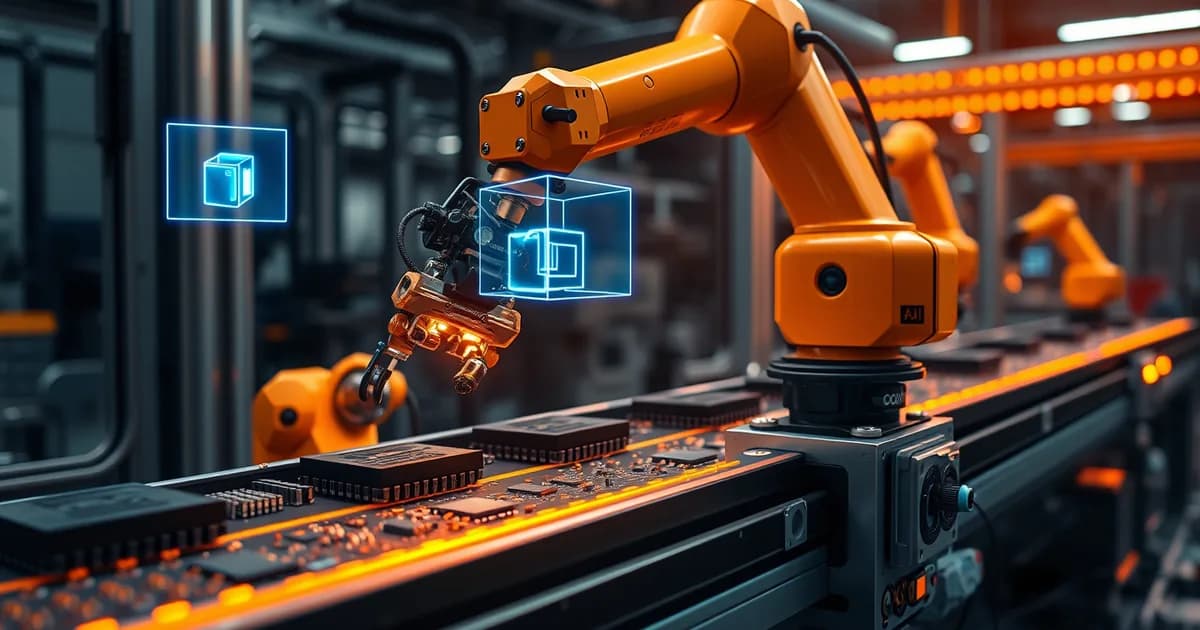
Pick-and-place is one of the most repetitive yet most critical tasks in any industrial production line. A missed grasp, a misaligned component, a slowed cycle — the impact on yield and operational costs is immediate. Over the past few years, SCARA robotics integrated with AI has fundamentally changed the rules of the game, transforming a rigid mechanical operation into an adaptive process capable of handling geometric variability, pose defects and new product references without stopping the line.
Market data confirms this shift: according to Mordor Intelligence, the SCARA robot market was valued at 2.45 billion in 2026 and is expected to grow at a CAGR of 9.63%, reaching 9.72 billion by 2031. The driver behind this growth is not mechanics — already mature — but embedded intelligence: artificial vision systems, deep learning models and real-time control architectures that enable intelligent pick-and-place even with stochastically positioned objects, on mixed lines and in environments subject to lighting variations.
The SCARA Robot as the Backbone of Industrial Pick-and-Place
The SCARA robot — Selective Compliance Assembly Robot Arm — was conceived at Yamanashi University in the 1980s with a precise insight: a 4-axis architecture combining fast horizontal movement and excellent vertical rigidity is the ideal geometry for assembly, insertion and planar manipulation tasks. This morphology still makes it the reference robot for pick-and-place in electronics, pharmaceuticals, automotive and food packaging industries.
Major manufacturers now offer highly specified platforms. FANUC has introduced the SR line, with models such as the SR-3iA (3 kg payload, 400 mm horizontal reach) and the SR-6iA/C, certified ISO Class 5 for cleanroom and food applications. The R-30iB Plus controller natively integrates iRVision, the proprietary 2D and 3D vision system, eliminating the need for external middleware for visual guidance. Omron offers the eCobra 600/800 family with the ACE (Automation Control Environment) software platform, which unifies programming of robots, vision systems and mobile robots in a single environment. Epson covers the spectrum from pure fast-cycle applications (T series) to medium payloads (G series), with native integration with its own cameras.
The critical point, however, is no longer the mechanics: it is the ability of these robots to see, understand and adapt in real time to what arrives on the conveyor belt.
How SCARA AI Robotics Redefines Line Flexibility
Traditional pick-and-place works well in highly structured environments: objects always in the same position, controlled lighting, a single product reference per shift. The moment any one of these constraints breaks down — format change, bulk objects, variable pose tolerances — the rigid system stalls or requires a machine stop for reprogramming.
SCARA AI robotics solves this bottleneck through three layers of intelligence:
- Adaptive perception: 2D and 3D cameras (typically depth via structured light or Time-of-Flight) capture images at every cycle and feed deep learning models to detect the object's position, orientation and class.
- Closed-loop kinematic planning: the 3D coordinates extracted from the vision system are translated into corrected kinematic trajectories in real time, compensating for thermal drift and mechanical vibrations.
- Incremental learning: some systems integrate on-device fine-tuning mechanisms, allowing the model to improve its accuracy as it accumulates real examples without requiring centralized retraining.
The practical result is a line capable of handling product mixes flexibly, with drastically reduced changeover times compared to the traditional approach.
Computer Vision and Deep Learning for Pick-and-Place
The technical core of an intelligent pick-and-place system is the object detection model. YOLO architectures — particularly YOLOv8 in its variants optimized for edge inference — have established themselves as the industrial standard for this task. Studies published on MDPI regarding real production line installations report detection accuracy of 97.3% with an average processing time of 31.1 ms per frame, a value compatible with the typical cycles of high-speed SCARA robots.
On the grasp success prediction front, classical machine learning models show interesting results: Support Vector Machine-based approaches achieve 94.4% accuracy in grasp success prediction, while Random Forest models estimate XY positioning error with an RMSE of approximately 1.84 mm, sufficient for most electronics assembly tasks.
Depth sensors integrated with RGB-D cameras add the third dimension necessary for bin picking — unstructured bulk picking — one of the most complex tasks in warehouse and line automation. Integration of these systems with SCARA controllers typically occurs through standard industrial protocols (EtherCAT, PROFINET) or via vendor-specific APIs.
Technical Architecture: Hardware, Models and Integration Layer
An AI-powered SCARA pick-and-place cell typically comprises these layers:
- Acquisition hardware: high-resolution 2D camera and depth sensor (structured light or ToF) mounted in eye-in-hand or eye-to-hand configuration, depending on the kinematics.
- Edge compute: compact GPU-accelerated processing unit that runs vision model inference in under 50 ms, without depending on cloud connectivity.
- Detection model: convolutional neural network optimized for the target (YOLOv8, EfficientDet or INT8 quantized variants to maximize throughput on edge hardware).
- Integration layer: middleware that translates 3D coordinates into robot-specific commands, manages the grasp/release logic and interfaces the system with the line PLC or MES.
One often underestimated element is exception management: a mature system must include recovery logic — retry, operator alert, bypass — for cases where the model confidence drops below a preset threshold. Process reliability, not just average accuracy, is the true KPI to monitor in production.
Competitive Advantage and Strategic Outlook
For an industrial decision maker, integrating AI into SCARA robotics is not a future option: it is already the differentiating factor between those who can manage the growing complexity of mixed production lines and those forced to maintain rigid setups, expensive to reconfigure with each product change.
According to industry data, 29% of Italian companies planning automation investments in 2026 are explicitly targeting robots with integrated AI, advanced perceptual capabilities and continuous learning. The trend is clear: competitive differentiation is shifting from pure mechanical speed — now standardized across major vendors — toward system intelligence, product flexibility and the ability to self-optimize over time.
SCARA AI robotics for intelligent pick-and-place does not require a technological leap to be tackled all at once. Current modular architectures allow for an incremental path: start with vision-guided integration on a pilot cell, measure accuracy and OEE KPIs, then scale. Competitive advantage is built data point by data point, cycle by cycle.