Rare Earth Recovery from E-Waste: Tech and Opportunity
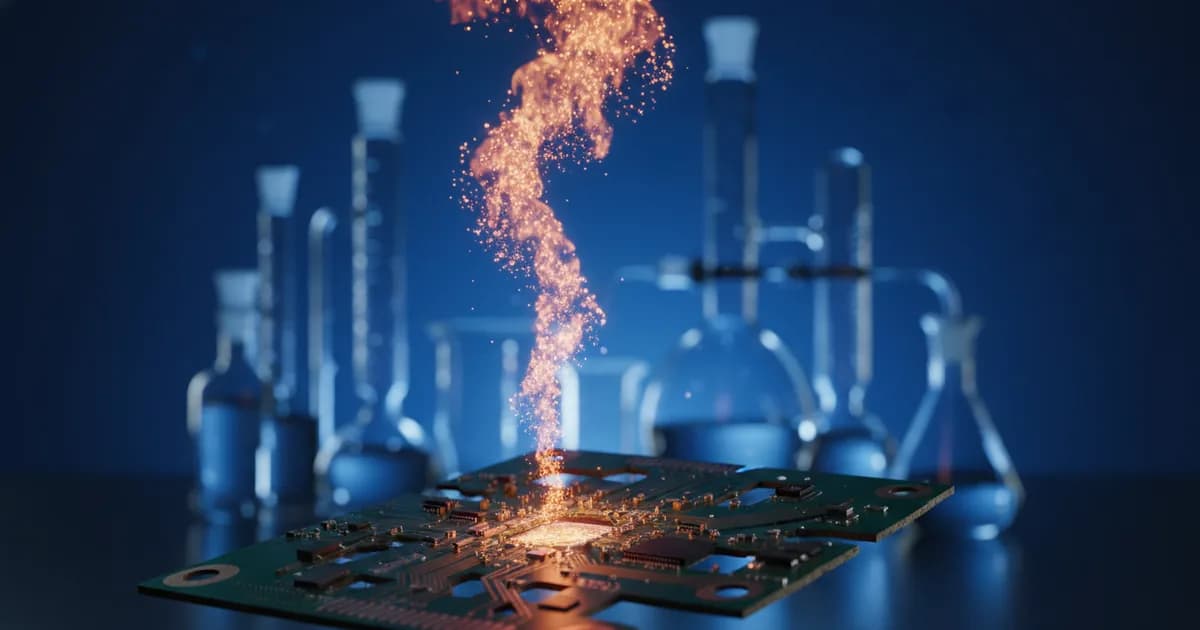
Less than 1% of the rare earths contained in end-of-life electronics is currently recovered. A figure that sums up, better than any other, the scale of industrial waste Europe leaves on the table every year. In 2022 the world produced more than 62 million tonnes of waste electrical and electronic equipment (WEEE), a quantity set to grow to roughly 82 million tonnes by 2030 according to the Global E-waste Monitor 2024. Of that, only 22.3% is formally collected and sent for treatment. The rest — electric motors, hard drives, e-bikes, medical devices — is dispersed, stockpiled, or processed in plants that recover copper and steel but leave all the rare-earth value in the slag.
For those running industrial plants, setting sourcing strategy, or responsible for environmental compliance, this is no longer just a regulatory issue: it has become a matter of operational resilience. EU Regulation 2024/1252 (the Critical Raw Materials Act) classifies rare earths among the strategic raw materials and sets a target of meeting at least 25% of the EU's annual consumption through recycling by 2030. The gap between that target and today's 1% defines both the challenge and the opportunity.
An above-ground deposit: rare earths in electronic waste
Rare earths are a group of 17 chemical elements — scandium, yttrium and the fourteen lanthanides — present in tiny quantities but essential to a growing number of technologies: permanent magnets for electric motors and wind turbines, displays, defence systems, fuel cells. Global demand is on a structural growth path, but primary-deposit extraction carries high environmental costs and, above all, critical geopolitical dependency.
According to International Energy Agency analyses published between 2024 and 2025, China holds a heavily dominant share of global rare-earth refining capacity, even when mining itself happens elsewhere. The real bottleneck isn't extracting the ore: it's separating, refining and turning it into an industrially usable material. That's exactly the value being lost today in e-waste.
A well-designed recycling plant can access rare-earth concentrations comparable to — and in some streams higher than — those of primary deposits. The term for this is urban mining: extracting raw material from the city, not the mountain.
Rare-earth recovery from e-waste: why almost none is recycled today
The reasons rare-earth recovery from e-waste has stayed marginal are structural, not technological. First, collection: in Italy in 2025, properly disposed-of flows reached around 6.2 kg per inhabitant, growing compared to previous years but still far from the standards of the EU's best-performing countries. Most e-waste stays in household drawers or is handled through informal channels that prioritise metals with the highest immediate recovery value.
Second, process economics: traditional plants recover common metals because they're present in concentrations high enough to justify separation costs. Rare earths, distributed in tiny quantities across heterogeneous components, require more selective and more expensive processes. Without adequate volumes and price certainty on output, the economics of the chain don't close.
Third, the technical complexity of disassembly: neodymium-iron-boron permanent magnets are assembled to maximise performance, not end-of-life separability. Eco-design, now enshrined as a principle in the EU regulatory framework, is still far from being systematically applied by manufacturers.
Hydrometallurgy versus pyrometallurgy: comparing technologies
Rare-earth recovery processes from e-waste fall into three main routes, each with distinct technical trade-offs.
Pyrometallurgy subjects e-waste to high temperatures — above 1,000°C — in the presence of reducing agents. Metals melt and segregate, allowing efficient recovery of some metallic fractions. The main limitation is high energy demand and the tendency for rare earths to disperse into smelting slag, making recovery difficult in later stages.
Hydrometallurgy is currently the most developed technology for selective recovery. The process happens in two stages: first, the material is treated with acidic solutions that dissolve the target metals; second, the dissolved metals are recovered through liquid-liquid extraction and selective precipitation. The technique is highly selective but requires managing corrosive reagents and neutralising effluents. The ROMEO process developed by Italy's ENEA agency has demonstrated, at pilot scale, a 95% yield in extracting precious metals from e-waste — gold, silver, platinum, palladium, copper, tin and lead — with significantly lower energy consumption than pyrometallurgical techniques.
Bioleaching represents the research frontier: microorganisms and biomass are used as selective agents to bind rare earths in solution. Laboratory results are promising, but the technology hasn't yet reached the scale needed for industrial application.
The regulatory framework: from the Critical Raw Materials Act to the 2030 targets
EU Regulation 2024/1252 has redefined the strategic scope of rare-earth recovery from e-waste. Beyond the 25%-from-recycling target by 2030, the CRMA requires that no single external source cover more than 65% of EU demand for any strategic raw material at any critical stage of the supply chain. This is a constraint that turns recycling from an environmental option into an industrial security requirement.
At the national level, Legislative Decree 49/2014 — transposing EU WEEE Directive 2012/19/EU — sets minimum recovery targets differentiated by WEEE category. For companies managing industrial equipment, servers and medical instrumentation in a B2B context, these changes mean reviewing disposal contracts: documentary compliance is no longer enough; you need to verify that the treatment operator can actually separate and recover rare-earth-bearing fractions.
Industrial models that work: the new economics of recycling
The most significant shift of the past two years isn't technological, it's financial. Institutional funds, venture capital and industrial investors are now treating rare-earth recycling as a strategic supply-chain component, not an ESG niche. In January 2026, North American startup Cyclic Materials closed a $75 million funding round, bringing its total raised to over $160 million. Its plant being commissioned in Mesa, Arizona, is designed to process around 2,000 tonnes of components — e-bike motors, hard drives, medical devices — recovering magnets and rare-earth oxides.
The economic model partly relies on co-products: copper recovered alongside rare earths helps fund the separation infrastructure, making the business case sustainable even in early phases. This lesson is directly transferable to Europe: plants that want to compete need to design their economics around multiple value streams, not rare earths alone.
The winning strategy: turning waste into a critical resource
For an industrial decision maker, rare-earth recovery from e-waste is no longer a line item in a sustainability report: it's a strategic asset to manage actively. Companies that move first to secure access to qualified WEEE streams, build or certify hydrometallurgical treatment capacity, and structure supply agreements with downstream manufacturers will end up in a competitive position that's hard to replicate in the medium term.
The EU regulatory framework, geopolitical pressure around dependence on China, and the convergence of private and public capital on this segment all point to a window of opportunity with a limited horizon. Whoever moves now — with the right technology, the right collection model and the right financial structure — will help build the secondary supply chain for critical raw materials that Europe can no longer afford to delay.