Copper Recovery from PCBs: Tech and Strategic Value
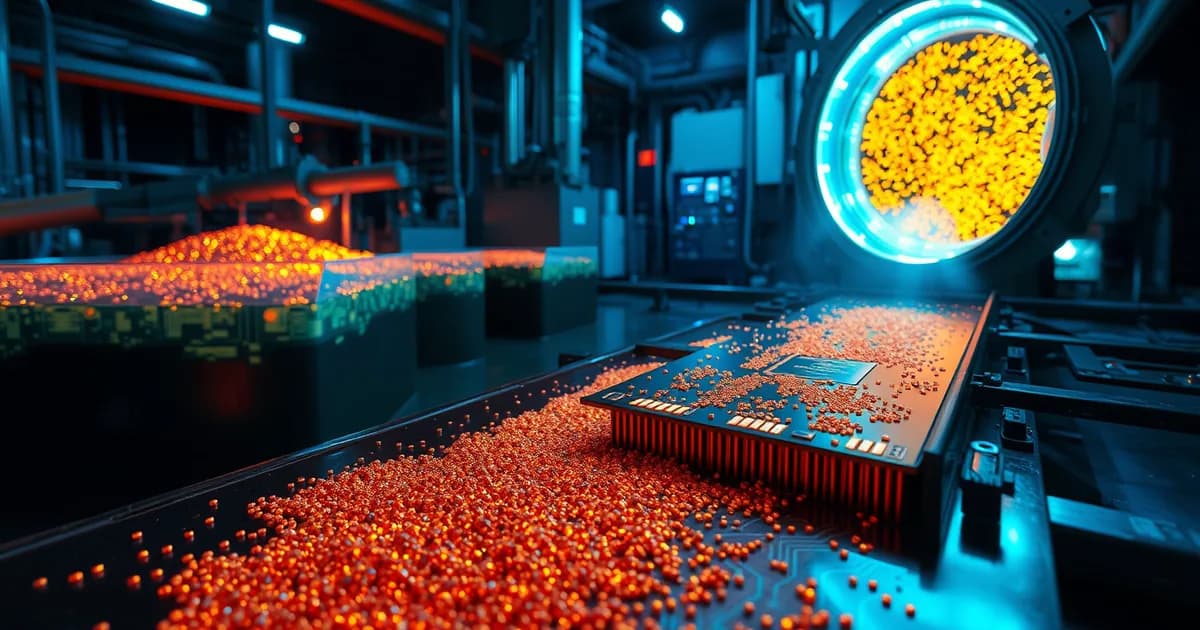
Copper is the nervous system of the digital economy: wiring, connectors, conductive traces, heat sinks. Every industrial circuit board contains a significant amount of it — up to over 200 kg per tonne in server and desktop PC boards — and the volume of discarded equipment grows every year. In a context where copper demand is being driven by the energy transition, AI data centres and transport electrification, recovering copper from PCBs is no longer just an environmental issue: it's a high-value strategic choice.
The global PCB e-scrap recycling market was worth around $700 million in 2024 and, according to industry estimates, will surpass $1 billion in the early part of the next decade. Copper is the dominant fraction of this market — around 44% of recovered value — ahead of precious metals such as gold, silver and palladium. For anyone managing industrial WEEE, understanding the available technologies means being able to negotiate better terms with treatment centres and concretely measure the environmental and economic return of disposal operations.
Why copper from PCBs is different from copper from ore
In traditional mines, copper concentration in extracted ore typically ranges between 0.5% and 2% by weight. A tonne of industrial PCBs contains roughly 100 to 200 kg: a concentration ten to forty times higher. This changes the economics of recovery radically. The challenge isn't material scarcity, it's matrix complexity: PCBs are laminated composites — epoxy resins reinforced with glass fibre, alternating metal layers, components soldered with tin-lead alloys, nickel or gold surface coatings. Separating copper from the other elements requires selective processes.
Morphological variability matters: a server motherboard, an SFP module, a PLC board all have different compositions. Characterising the incoming material — through XRF analysis or acid-dissolution sampling — is a prerequisite for optimising downstream process yield.
Pyrometallurgy: the established route for large volumes
The pyrometallurgical route is the dominant technology at large industrial-scale recovery plants. The process involves melting PCBs in plasma furnaces or reverberatory furnaces at temperatures above 1,200°C. Metals melt and separate by density: copper and precious metals concentrate into a metallic alloy (blister copper), while non-metallic fractions — glass, silica, oxides — form a vitrified slag.
The blister copper obtained — typically 85-95% purity — requires a final electrolytic refining step to reach commercial-grade cathode copper purity (≥99.99%). Operators such as Umicore and Boliden, which together control more than 38% of the global PCB recycling market, base their operations on this architecture, processing hundreds of thousands of tonnes annually.
Pyrometallurgy's limitation is energy impact and associated emissions. Combustion of organic fractions (resins, plastics) generates usable heat but also produces acid gases and dioxins that require advanced abatement systems. For companies reporting under ESG standards and measuring Scope 3 emissions, this is an increasingly relevant factor in choosing a treatment partner.
Hydrometallurgy: selectivity and purity for specialised streams
Hydrometallurgy is the preferred route for high-copper-concentration streams, where the goal is to recover the metal at high purity with lower thermal impact. The process has three main stages:
- Leaching: pre-treated PCBs (shredded and mechanically separated from glass fibre) are immersed in acidic solutions — typically sulfuric acid with oxidising agents such as hydrogen peroxide or ferric chloride. Copper goes into solution as Cu²⁺ ions, with extraction efficiencies that, according to recent scientific literature, exceed 95% under optimised conditions.
- Solvent extraction (SX): the leach solution, which also contains other metal ions, is treated with selective organic extractants (such as LIX 84IC or equivalent reagents) that preferentially bind copper, separating it from zinc, nickel, iron and precious metals that remain in the aqueous phase.
- Electrowinning (EW): purified copper is electrodeposited onto stainless steel cathodes. Results published in recent studies indicate deposit purities around 99% with current efficiencies above 94%.
The end product is high-purity cathode copper, directly marketable without further refining. The process generates acidic effluents and solid residues that must be managed under Legislative Decree 152/2006 (the Environmental Code) and, if classified as hazardous waste, according to the specific requirements of the plant's IEA/AUA permits.
Mechanical pre-treatment: the stage that determines yield
Regardless of whether the hydrometallurgical or pyrometallurgical route is chosen, the quality of mechanical pre-treatment is a critical, often underrated factor. Boards must be disassembled or shredded to liberate metallic fractions from the polymer matrix. The most advanced shredding-separation lines combine hammer mills, eddy-current separators and density tables to produce an enriched metallic fraction — copper granulate or mixed metal powder — that serves as the optimal feed material for downstream processes.
Automating this stage, with vision systems for classifying incoming board types, makes it possible to optimise the processed mix and increase the overall yield of the recovery cycle.
The regulatory framework and recovery traceability
Recovering copper from PCBs in Italy is governed by Legislative Decree 49/2014, which transposes EU WEEE Directive 2012/19/EU, and by the Environmental Code (Legislative Decree 152/2006). Treatment centres that carry out recovery operations (R-codes) must be registered with the National Register of Environmental Operators under the relevant categories. The RENTRI system has introduced digital traceability obligations for special waste, including professional WEEE: the electronic waste tracking form (FIR) is the tool used to document the material's path from waste generation to the recovery centre.
For companies generating professional WEEE (decommissioned equipment, IT hardware, electronics production lines), correctly documenting the recovery flow — with treatment certificates and quantitative data on recovered materials — is both a compliance obligation and an advantage for ESG reporting: the CO₂ avoided through secondary copper recovery, compared with primary ore production, is a figure that adds value to sustainability reports.
The competitive advantage of structured recovery
Copper recovery from PCBs sits at the intersection of three converging trends: the structural growth in the global copper supply deficit, rising volumes of industrial WEEE generated by accelerated technology refresh cycles, and tightening environmental reporting obligations for businesses. Organisations that build structured recovery chains — with careful stream selection, well-chosen treatment partners and full traceability — position themselves favourably compared with those who treat WEEE as a cost to minimise. The ability to document the material lifecycle is becoming a selection criterion in public tenders and ESG supply-chain assessments: copper recovered from PCBs is, first and foremost, a strategic asset to be managed deliberately.