Silver Recovery from Industrial E-Waste: Tech and Strategy
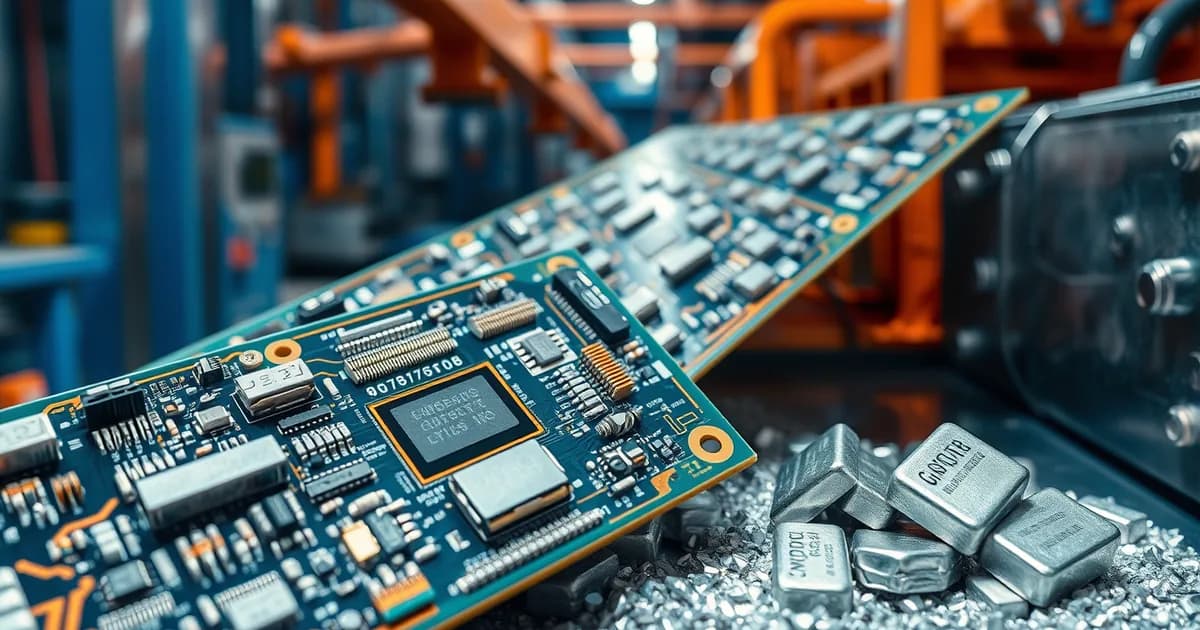
Every year, hundreds of thousands of tonnes of waste electrical and electronic equipment (WEEE) are managed across Europe. Within these flows — often sent to low-efficiency disposal routes — lies a forgotten asset: precious metals including gold, palladium, and silver. The latter is present in significant concentrations in printed circuit boards, connectors, electrical contacts, and lead-free solder alloys in industrial electronics. For a decision maker responsible for end-of-life assets or a professional B2B WEEE stream, overlooking this value means transferring wealth to the treatment supply chain rather than capturing it internally.
The global market for precious metals recovery from e-waste is estimated at over ten billion dollars today and is expected to grow steadily over the coming years, driven by commodity price volatility, 5G expansion, and the electric vehicle transition, all of which increase structural demand for industrial silver. For companies generating professional WEEE or processing end-of-life electronics, the ability to properly valorize silver recovery from industrial e-waste is an increasingly relevant competitive differentiator.
The Value of Silver in Industrial E-Waste
Silver is not a marginal metal in industrial electronics. It is present in relay and switch contacts, lead-free solder alloys, high-reliability connectors, multilayer ceramic capacitors (MLCC), and screen-printed conductive pastes on circuit boards. Its selection is functional, not aesthetic: silver has the highest electrical and thermal conductivity of all metals, making it irreplaceable in specific high-performance industrial components.
In electronics designed for industrial environments — servers, PLCs, inverters, industrial control boards — precious metal concentrations tend to be higher than in consumer devices, because reliability requirements call for higher-grade components. Silver recovery from industrial e-waste therefore becomes an economically significant activity when operating at meaningful volumes of industrial electronic waste.
Where Silver Concentrates in Electronic Components
Not all WEEE contains silver in the same proportion. Optimizing recovery requires understanding the metal's distribution across component types. Electromechanical contacts and relays are among the richest fractions: silver-copper alloys have long been used for power contacts due to their arc resistance. PCB surface finishes such as lead-free HASL contain tin-silver alloys, while certain high-reliability finishes include thin chemically deposited silver layers.
Multilayer ceramic capacitors (MLCC) from older generations use internal electrodes in silver-palladium alloys, making them particularly valuable for their dual precious metal content. Screen-printed conductive pastes based on silver are widely used in membrane interfaces and industrial control panels. Finally, RF and high-frequency connectors are often silver-plated to meet the conductivity requirements of industrial telecommunications applications.
Hydrometallurgical Technologies: The Recovery Process
The most technically promising route for industrial-scale silver recovery from e-waste is hydrometallurgy, which differs from traditional pyrometallurgy in its lower energy consumption and significantly reduced environmental footprint. The process typically follows four main stages.
The first stage is mechanical pre-treatment: circuit boards are dismantled, freed from hazardous components (batteries, capacitors containing regulated substances), and shredded to controlled particle sizes, yielding a metal-rich powder. In the second stage, selective leaching, the shredded material is immersed in specific reagent solutions — acids or complexing agents — that preferentially dissolve noble metals. For silver, dissolution typically occurs via reactions that form stable metal complexes in solution.
The third stage, separation and purification, selectively precipitates silver from solution or recovers it electrochemically through electrodeposition onto cathodes, achieving purity levels suited for jewelry and refinery specifications. Finally, re-melting and refining converts the precipitate into bars or granules ready to re-enter the production cycle.
A concrete example is the plant built by Gruppo Iren at Terranuova Bracciolini (Arezzo, Tuscany), the first in Italy to apply a hydrometallurgical process to the industrial-scale treatment of WEEE circuit boards. Authorized by the Tuscany Region at the end of 2023 and developed with partners Osai Green Tech and BTT Italia, the facility processes over 300 tonnes of circuit boards per year. Annual output includes over 200 kg of gold and comparable quantities of silver, directed primarily to the local goldsmithing district. According to the company, the process generates twenty times less CO₂ than traditional extraction methods.
Urban Mining: Efficiency vs. Primary Extraction
The concept of urban mining — recovering raw materials from urban and industrial waste streams — has gained strategic importance in the transition to a circular economy. For silver, WEEE represents a secondary source with concentrations significantly higher than many primary ore deposits. Circuit boards contain precious metal densities that make their processing economically compelling at industrial scale, provided the collection, pre-sorting, and treatment supply chain is organized efficiently.
Unlike conventional mining, urban mining from e-waste requires no invasive extraction activities, can operate close to the industrial centers generating the waste, and returns materials to the local production cycle, reducing dependence on critical raw material imports. For Italian companies in electronics-intensive sectors — advanced manufacturing, automotive, energy tech, industrial telecommunications — integrating a structured silver recovery from e-waste process into end-of-life asset management can reduce disposal costs while generating revenues from secondary raw materials.
Regulatory Framework and ESG Value
WEEE management in Italy is governed by the national transposition of the European WEEE Directive, which places collection, treatment, and recycling obligations on producers of electrical and electronic equipment, with recovery targets by equipment category. For professional B2B WEEE, responsibility for adequate treatment falls on the producer or on whoever contractually assumes that responsibility in the supply chain.
Treatment operations involving precious metals recovery fall under the recovery operations framework of the national Environmental Code and require the appropriate environmental permits. Facilities must be registered with the National Environmental Managers Register. Beyond compliance, structured silver recovery from WEEE generates measurable ESG value: avoided CO₂ relative to primary extraction, reduced dependence on critical raw materials, and traceability of recovered material are all reportable under CSRD, with a direct impact on the organization's sustainability rating.
Turning Silver Recovery into Competitive Advantage
The silver recovery from industrial e-waste supply chain is still maturing in Italy, but structural conditions — regulatory, technological, and market-driven — are converging toward a concrete window of opportunity. Companies that invest now in accurate pre-sorting of WEEE streams, capable of separating precious metal-rich fractions from low-value ones, position themselves to benefit from the structural appreciation of critical raw materials and growing ESG reporting requirements.
The key to capturing this value is not necessarily building in-house treatment facilities, but structuring intelligent collection and pre-sorting supply chains, paired with partnerships with licensed specialist facilities that guarantee transparency on metallurgical yield and material traceability. Building this capability today means transforming what is often still a disposal cost into a measurable source of economic, environmental, and strategic value.