Reverse Logistics for B2B Professional WEEE: Guide
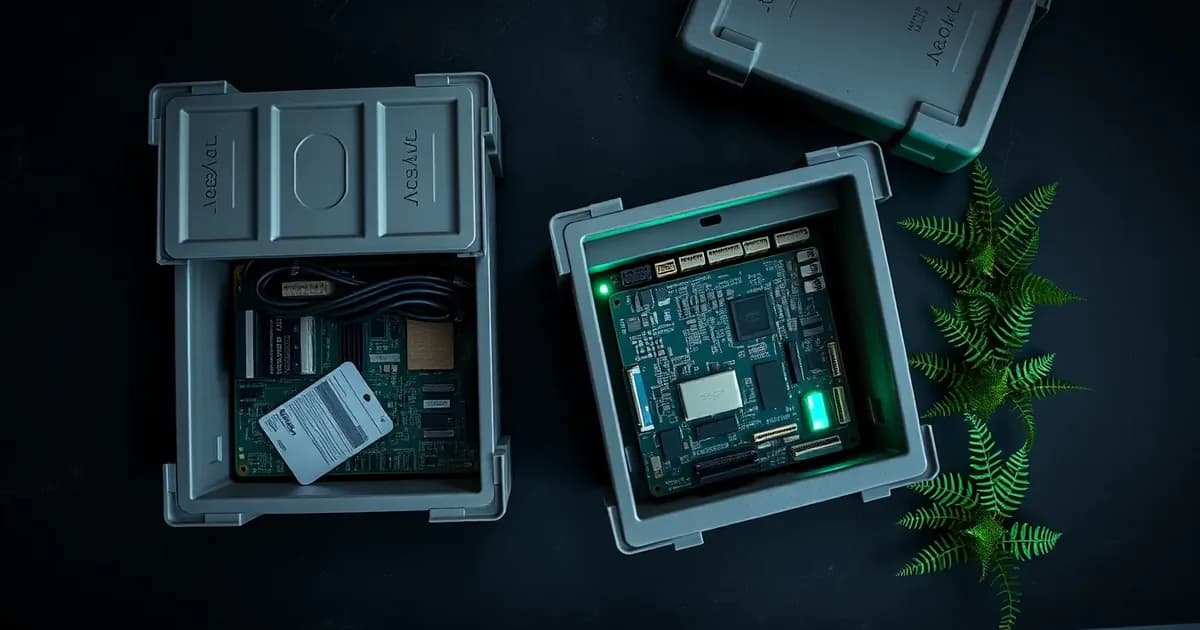
Every year, decommissioned servers, inverters, machine tools, network equipment and control cabinets leave production sites and offices. For these streams, reverse logistics for professional WEEE is not an optional service: it is the process that decides whether a device becomes a tracked resource or a compliance risk. Unlike household WEEE, there is no dense network of municipal collection points ready to receive this waste, so each route has to be designed case by case.
The topic concerns producers, distributors, installers, maintenance providers and the companies that hold the equipment, each with different roles and responsibilities. Where the chain is disorganised, transport costs, storage times and documentation errors grow; where it is governed, companies get reliable data, predictable material recovery and a solid position in case of inspection.
Reverse logistics for professional WEEE: why it is strategic
Under Italian rules, referring to Legislative Decree 49/2014, professional WEEE is waste from electrical and electronic equipment other than that generated by private households. The distinction therefore concerns the type of equipment and its use, not only who disposes of it. It brings its own rules on financing, collection and destination.
In practice, professional WEEE is normally not delivered to municipal collection centres: it follows a dedicated route to the treatment plant indicated by the producer or by the collective scheme it belongs to. This turns B2B reverse logistics into a planning problem: agreed pick-ups, authorised vehicles, suitable packaging and paperwork ready before the truck arrives.
Who pays and who is responsible: allocating responsibilities
The underlying principle is the producer's financial responsibility, exercised individually or through a collective scheme, for equipment placed on the market after the regime came into force. For so-called "historical" equipment, the cost of management normally falls on the holder, with exceptions linked to taking back equivalent equipment when a new product is supplied.
The producer remains responsible for every phase, including pick-up and transport to collection or treatment centres. Distributors, installers and service centres may carry out some operations, but only under a formal mandate. For a company holding equipment, this means checking, before disposal, which category the device belongs to and who bears the cost.
One-to-one take-back and the producer's mandate
One-to-one take-back lets a distributor, when delivering new equipment, collect the equivalent old unit. For professional WEEE this mechanism works only if the producer has granted a written mandate and the distributor's name appears in its registration with the national register of environmental managers. Equivalence lapses when the returned equipment weighs more than twice the delivered unit: in that case the cost stays with the holder.
Grouping of WEEE also follows precise rules and, for professional equipment, likewise requires a formal mandate. A distributor operating in this field registers in the dedicated section of the register, stating whether it handles household or professional equipment, its storage sites and the waste codes involved.
Traceability: waste forms, registers and RENTRI
This is where reverse logistics becomes compliance. Waste transport requires the waste identification form (FIR) or, in the cases provided for, the simplified transport document for distributors. Obliged parties keep the chronological loading and unloading register according to the models of Ministerial Decree of 4 April 2023 and manage data through RENTRI, the national electronic register for waste traceability.
The RENTRI calendar was staged by company size: launch on 15 December 2024, registration for treatment plants and companies with more than 50 employees from 13 February 2025, for those with 10 to 50 employees from 14 August 2025, and for other obliged parties from 13 February 2026. 15 September 2026 is indicated as the end of the transitional period in which paper and digital forms (xFIR) could be used alternatively. Some categories are excluded, so the check must be made for each company and each stream.
- Waste producer: classifies the waste, completes the FIR and verifies the carrier's authorisation.
- Carrier: registered for the right category, delivers the load to the indicated recipient.
- Destination plant: confirms acceptance and closes the documentation cycle.
From the customer site to the plant: planning the flow
An efficient B2B flow is built upstream. The first step is the inventory: type, weight, condition and presence of hazardous components or batteries. The second is choosing the channel: pick-up through the producer or collective scheme, a mandate to a distributor, or delivery to an authorised manager. The third is storage management: grouped WEEE is subject to time and quantity limits, and storage must prevent breakage and dispersion.
Technology helps concretely here. Identification labels on containers, weighing at pick-up, photographs of the load and structured data make it possible to reconcile what leaves the site with what arrives at the plant. For equipment with high recovery value, such as boards and electronic modules, separate and protected collection preserves material quality and reduces losses in later treatment stages.
Finally, data held on devices must be considered: servers, storage and network equipment require secure erasure before leaving company premises, with a procedure recorded together with the pick-up.
The competitive advantage of a governed reverse chain
Treating reverse logistics for professional WEEE as a process rather than an end-of-life cost brings measurable benefits: fewer wasted pick-ups, consistent documents, lower exposure to penalties and a data base useful for sustainability reporting. For those who make or manage equipment, offering customers a clear take-back path becomes part of the value of the service.
Those who want to go deeper can start with three checks: map the professional WEEE streams in the company, review roles and mandates along the pick-up chain, and verify that registers and forms are aligned with RENTRI. From there, the choice of treatment partners and the level of traceability become strategic, not just operational, decisions.