Reverse Logistics for B2B E-Waste Compliance
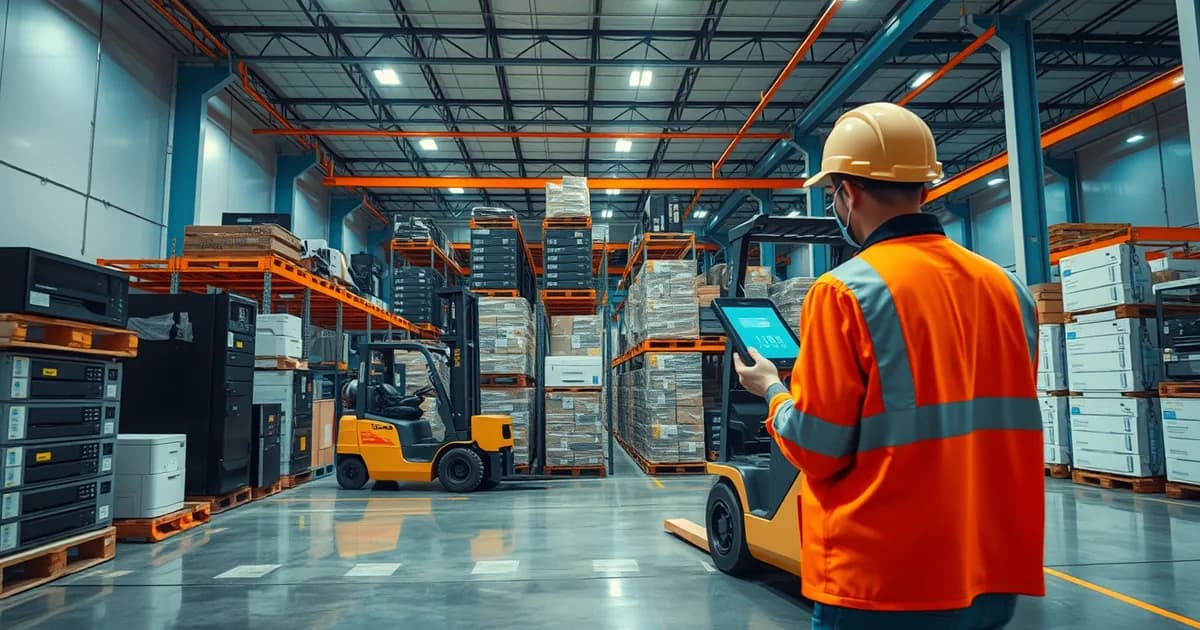
Companies that generate waste from professional electrical and electronic equipment — decommissioned servers, industrial printers, medical devices, vending machines — now face a dual constraint: on one side, the digital traceability requirements imposed by Italy's national waste tracking register (RENTRI); on the other, a recovery market that is still loosely structured. According to data released by Erion Professional, Italy's main consortium dedicated to professional e-waste, only a fraction of B2B electronic waste is collected through official channels, with a significant share of decommissioned equipment ending up with unregistered operators in the open market, outside any official reporting. In this scenario, reverse logistics for e-waste stops being an accessory cost and becomes a lever for regulatory compliance, reduced sanction risk, and, for better-organized companies, recovered economic value from the critical materials inside discarded devices.
What B2B e-waste reverse logistics actually involves
It is the set of processes that bring a decommissioned electronic device back from its point of use — an office, a production plant, a hospital — to an authorized treatment facility, passing through collection, transport, temporary storage and documentation. For the professional (B2B) segment, the flow differs structurally from the consumer one: volumes are less predictable, equipment often contains sensitive data that must be certified as erased, and the producer's or holder's responsibility for the waste stays traceable throughout the chain until final disposal. Well-designed reverse logistics for e-waste shortens on-site storage time, prevents the accumulation of unrecorded material, and lets a company demonstrate full process compliance if audited.
RENTRI and the digital waste form: what changes for the professional e-waste chain
The regulatory framework is RENTRI, Italy's national electronic waste traceability register managed by the Ministry of Environment and Energy Security, established by Ministerial Decree No. 59 of April 4, 2023, implementing Article 188-bis of Legislative Decree 152/2006. The system replaces paper load/discharge registers and the waste identification form (FIR) with a digital version (xFIR). With the registration window for the last tier of mandatory subjects closing on February 13, 2026, the digital waste form became the operating standard even for smaller producers of non-hazardous waste with more than ten employees. For transport operators, this means mandatory RENTRI registration, use of the dedicated app or data transmission via API, updated mobile devices (Android 10 or later, iOS 16 or later), and an annual fee that indicatively ranges between 10 and 100 euros depending on company size and activity. For anyone managing this flow in-house or through third-party operators, this translates into continuous tracking: every movement, from pickup at the client's site to discharge at the treatment facility, must be logged electronically and remains available for inspection.
From pickup to traceability: how the chain is structured
An efficient B2B process typically follows a recurring sequence: inventory and classification of decommissioned equipment at the client's site, completion of the digital waste form at pickup, transport with an authorized vehicle (hazardous waste requires registration in the relevant category of Italy's National Register of Environmental Operators), tracked temporary storage, and finally delivery to the treatment facility where material recovery begins. The quality of this chain directly determines downstream recovery quality: a disorganized flow, with mixed and uncategorized equipment, reduces treatment plant efficiency and the purity of recoverable fractions, while selective upstream collection — separating, for instance, IT equipment from devices containing batteries or hazardous components — meaningfully increases recoverable value and simplifies documentation.
Italy's collection gap and the opportunity for structured companies
The numbers confirm how much room for improvement exists. Erion as a whole managed over 289,000 tonnes of waste in 2025, up 8% from 2024, of which roughly 4,040 tonnes were specifically professional e-waste. That is meaningful growth, but according to Erion Professional's leadership it still falls short of closing the gap against European collection targets for this waste category. The core problem is not a shortage of material to recover, but its dispersion toward untracked channels: decommissioned equipment handed to unregistered operators, outside any official reporting. For companies that build compliant e-waste reverse logistics — with authorized partners, end-to-end digital traceability and consistent reporting — this is a concrete opportunity: verifiably demonstrating proper end-of-life management of their equipment, with direct benefits both in reduced sanction risk and in the environmental reporting increasingly expected by stakeholders.
Technology and automation behind the e-waste supply chain
Digitalizing this chain goes beyond regulatory compliance alone. IoT tracking on collection containers, pickup-order management platforms integrated with the digital waste form, and automated reporting tools for quantities managed per waste category let companies turn a documentation obligation into a data stream useful for planning. Some industry operators are also experimenting with local treatment facilities sized to process regionally collected flows before shipment to large centralized recovery plants, cutting the distance waste travels and the associated logistics costs and impact.
Conclusion: reverse logistics as a competitive edge
Over the coming years, regulatory pressure on professional e-waste traceability is set to increase rather than ease: RENTRI has already shifted the compliance bar toward fully digital data, and Italy's gap against European collection targets suggests further regulatory action in upcoming cycles. Companies that invest today in structured e-waste reverse logistics — with authorized partners, digitized processes and solid reporting — gain a dual advantage: lower exposure to non-compliance risk and a stronger ability to demonstrate, with verifiable data, their contribution to the circular economy. As traceability becomes mandatory infrastructure rather than an option, early adopters turn a compliance cost into an information asset that less organized competitors will struggle to replicate.