Nvidia Jetson Integration for Industrial Edge AI
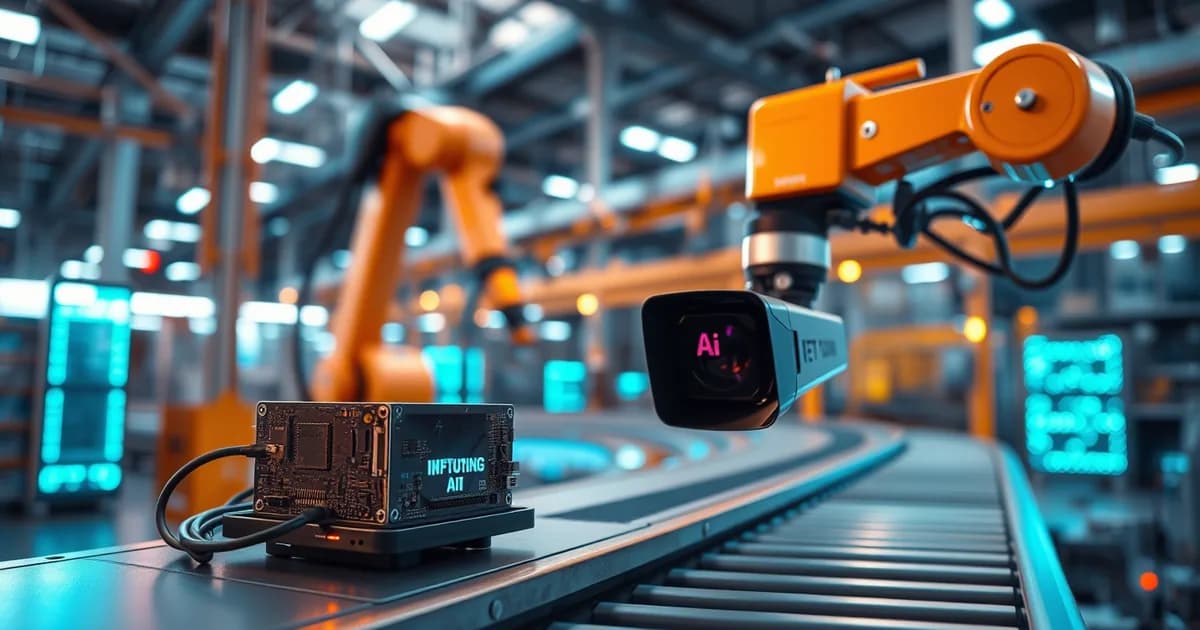
On factory floors squeezed by tight margins and costly downtime, the question is no longer whether to adopt artificial intelligence, but where to run it. Nvidia Jetson integration has become one of the most concrete answers to that problem: pushing inference directly onto the line, instead of relying on the latency and connectivity costs of a remote data center. In early June 2026, at Computex in Taipei, Nvidia unveiled JetPack 7.2 and support for its NemoClaw agentic framework on Jetson, marking a shift of agentic AI from servers into the physical world — robotics, visual inspection and industrial automation. For IT and sustainability decision makers, this means the window to plan a competitive Jetson integration is opening right now, before it becomes the industry default.
Why Nvidia Jetson integration is a strategic priority
The advantage of edge AI over the cloud is, first and foremost, operational: processing images, signals and sensor data directly on the device cuts latency, improves reliability where connectivity is unstable, and limits exposure of sensitive process data. For an industrial decision maker, this translates into three concrete value drivers: less downtime caused by cloud round-trips, lower bandwidth and storage spend, and tighter control over where and how production data is handled. Nvidia's Jetson platform is today the most widely adopted hardware base for this kind of deployment, backed by an ecosystem of partners, distributors and integrators that has lowered the entry barrier considerably compared to just a few years ago.
Inside the Jetson lineup: from Orin modules to Jetson Thor
The Jetson family today spans several performance tiers built for different use cases. Jetson Orin Nano modules deliver up to 67 TOPS of AI performance at a configurable 7–25 W, making them the entry point for low-power vision and classification projects. Jetson Orin NX scales up to 157 TOPS (10–40 W) in the family's most compact form factor, while Jetson AGX Orin remains the reference point for heavier workloads, rated at up to 275 TOPS with a 15–60 W power envelope; the 32GB AGX Orin module also received a roughly 20% performance boost through the JetPack 7.2 software update, reaching 241 TOPS. At the top of the range sits Jetson Thor, built for physical AI and advanced robotics, with a configurable 40–130 W envelope and a performance jump Nvidia rates at over 7.5x compared with AGX Orin, alongside roughly 3.5x better energy efficiency. This scalability is the key point for anyone planning a Nvidia Jetson integration: the same software stack — JetPack, CUDA-X — spans everything from the simplest sensor node to the most complex robotic cell, letting teams size hardware to the actual use case without switching development ecosystems.
JetPack 7.2 and agentic AI on the factory floor: what's changing
JetPack 7.2 introduces three layered capabilities. At the base, a leaner operating system: Yocto Project support gives industrial customers a lighter, more customizable Linux foundation, important for memory-constrained deployments, while the arrival of CUDA 13 brings the latest compute stack to already-deployed Orin devices. In the middle, a layer of "agent skills" automates development tasks such as Linux customization, memory optimization and model benchmarking. At the top sits NemoClaw, Nvidia's agentic AI framework, which the company says deploys to Jetson with a single command and brings autonomous reasoning and planning capabilities directly to edge devices. On Jetson Thor, JetPack 7.2 also adds Multi-Instance GPU (MIG) support paired with a real-time kernel, a feature designed to reserve dedicated GPU resources for deterministic workloads — such as robotic perception systems that cannot tolerate interruptions from other concurrent AI workloads.
Real-world industrial integration cases
Several examples Nvidia made public around the launch help show where adoption is concentrating. Advantech is building an "agentic factory brain" inside its own manufacturing facilities, based on Jetson Thor and NemoClaw, to automate robot fleet management, intelligent defect detection and autonomous decision-making. SandStar uses Jetson Orin NX with NemoClaw to power smart vending machines and retail operations across more than 30 countries, reporting roughly 40% memory optimization that let it migrate from 16GB to 8GB devices and cut deployment costs. NoTraffic, active in intelligent traffic management, reports cutting memory usage by roughly 29% by optimizing CUDA library compilation, with a direct effect on real-time inference speed. Closer to industrial quality control, Jetson-based solutions are already used for visual inspection on production lines, where industrial cameras paired with convolutional neural networks running on the edge device can flag anomalies — such as misaligned containers on a conveyor belt — without streaming every frame to a remote server.
How to evaluate a Jetson integration: the criteria that matter
For a company evaluating adoption, choosing the right Jetson module depends on three main variables: the number of concurrent AI pipelines required (more sensors and parallel models push toward Orin NX or AGX Orin), the power and thermal constraints of the installation environment, and whether advanced agentic capabilities are needed — territory where Jetson Thor is currently the most mature option. Equally important is the software ecosystem: JetPack and CUDA-X guarantee code portability across modules, reducing the risk of rewriting the inference pipeline when moving from a prototype to a higher-tier production device. One often underestimated factor is fleet management over time: device fleet management tools and customized Linux distributions become relevant not at pilot stage, but once Nvidia Jetson integration scales to dozens or hundreds of units distributed across multiple plants.
The competitive edge of early movers
Industrial edge AI is rapidly moving from pilot project to production infrastructure, and the availability of a native agentic framework on Jetson hardware further lowers the complexity threshold for automating inspection, robotic fleet management and operational decisions directly on the line. Companies building their Nvidia Jetson integration roadmap today — choosing the right module, planning the software stack, and putting fleet management processes in place — are positioned to absorb each new performance leap from the platform faster, keeping a competitive edge that's hard for late movers to close. The direction Nvidia has set with JetPack 7.2 suggests the next innovation cycle won't be defined only by available compute power, but by how quickly companies can turn it into autonomous, reliable industrial processes.