Hydrometallurgy for WEEE: When It Beats Pyrometallurgy
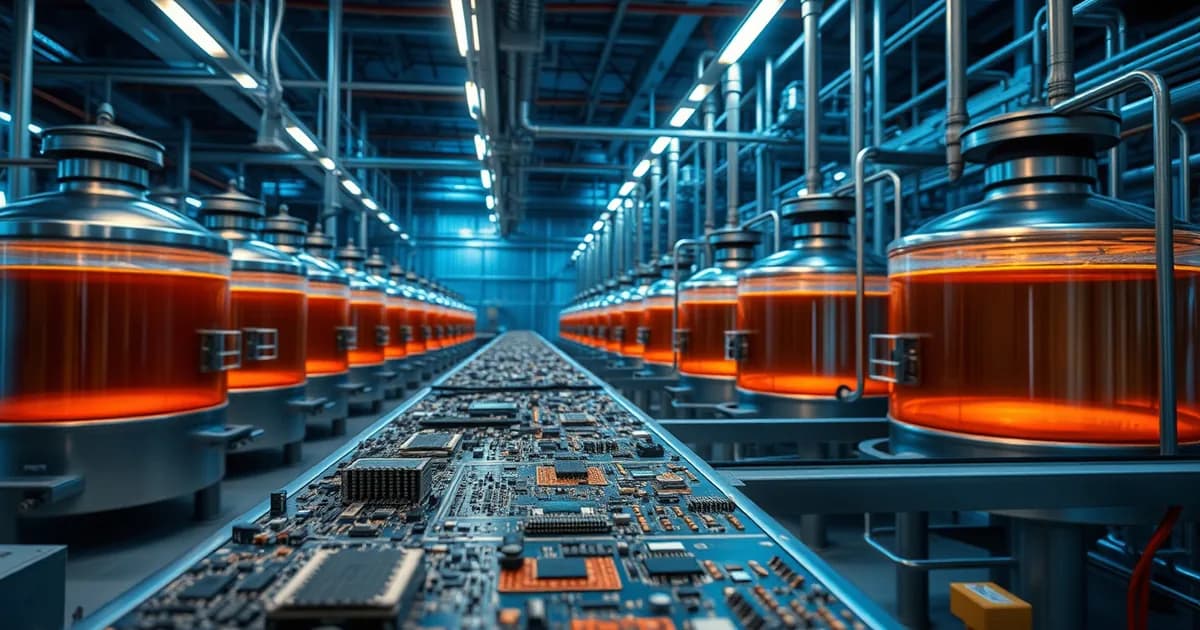
Every tonne of discarded circuit boards holds concentrations of copper, gold and palladium higher than those found in many primary ore deposits. For anyone processing WEEE at industrial scale, that fact raises a sharp strategic question: which process extracts those metals while maximising yield, margins and environmental compliance? The issue is far from academic. Regulation (EU) 2024/1252, the Critical Raw Materials Act that entered into force on 23 May 2024, aims to cover a growing share of Europe's strategic raw-material consumption through internal recycling by 2030, and lists copper among its key materials. Electronic-waste operators therefore face a technological fork that directly shapes operating costs, environmental footprint and market positioning.
Hydrometallurgy for WEEE: why the process choice drives the business
Choosing between the two main treatment families is not a plant-engineering detail reserved for technicians. It sets the facility's energy profile, the permits required, the purity of the output metals and, ultimately, the value recovered per tonne processed. Hydrometallurgy for WEEE and pyrometallurgy are opposite answers to the same challenge: releasing the precious and base metals locked inside the complex matrices of printed circuit boards. Understanding their differences, strengths and limits is the precondition for building a recovery line that is both competitive and compliant.
Pyrometallurgy: high-temperature smelting and its limits
Pyrometallurgy recovers metals thermally: smelting and reduction at high temperature concentrate the metallic fraction into a liquid phase, from which the target elements are extracted through further steps. Smelting processes typically run at very high temperatures, well beyond the melting point of the materials, which means substantial energy consumption and gaseous emissions to control.
The historical advantage of this route is robustness: plants handle heterogeneous streams and high volumes without heavy pre-treatment. The downside lies in energy intensity, air emissions that require dedicated abatement, and the difficulty of selectively recovering certain elements, which can be lost to the slag. For rich but delicate streams such as circuit boards, these limits translate into a meaningful cost and permitting risk.
How hydrometallurgy works: leaching and selective recovery
Hydrometallurgy takes the opposite path: instead of heat, it uses aqueous solutions and chemical reagents, acids or leachants, to dissolve metals selectively at much lower temperatures. The metal is brought into solution through leaching, then separated and purified with techniques such as solvent extraction, cementation, ion exchange or electrowinning. The result is targeted, element-by-element recovery with finer process control.
That selectivity is precisely why most research on recovering base and precious metals from circuit boards focuses on hydrometallurgical techniques: they are more exact, predictable and easily controlled. Operating at low temperature and with reduced air emissions, hydrometallurgy also suits smaller-scale plants and distributed recovery models. Its Achilles heel is effluent management: leaching stages generate process water loaded with contaminants, which must be treated carefully so the environmental burden is not simply shifted from one medium to another.
Yield, purity and energy: the technical comparison
In performance terms, advanced recycling techniques, both hydrometallurgical and pyrometallurgical, can recover high shares of the metals contained in the boards, with significant product purities. The comparison, however, is not about gross yield alone but about the overall balance among three variables: energy consumption, selectivity and environmental impact.
- Energy: the thermal route demands far more energy than the hydrometallurgical one, which operates at markedly lower temperatures.
- Selectivity: hydrometallurgy isolates individual elements with greater precision, a valuable trait when the mix contains high-value gold, palladium and copper.
- Emissions: pyrometallurgy shifts the problem to air emissions; hydrometallurgy concentrates it in liquid effluent. In both cases, real sustainability depends on the quality of the abatement systems.
This is why the choice is never absolute. Many advanced plants adopt hybrid schemes, in which physical or thermal pre-treatment precedes a hydrometallurgical refining stage. The guiding criterion remains the composition of the incoming stream and the purity targets for the output metal.
Regulation and market: the Critical Raw Materials Act drives urban mining
The regulatory context makes this choice even more strategic. The Critical Raw Materials Act sets ambitious 2030 targets for European autonomy in strategic raw materials, calling for a sharp increase in the share covered by internal recycling and recovery. In parallel, through Implementing Regulation (EU) 2026/1116 the Commission has identified waste streams, WEEE included, with high recovery potential, effectively turning electronic-waste management into a structured urban-mining activity. For operators, this means that the ability to recover copper and precious metals through efficient, traceable processes becomes a regulatory asset as well as an economic one.
The competitive edge of choosing the right process
Reducing the matter to a contest between hydrometallurgy and pyrometallurgy would be misleading. The real competitive lever lies in sizing the process around the actual stream, the purity targets and the plant's permitting framework. An industrial decision maker who masters these differences can turn a regulatory constraint into a margin: less wasted energy, purer metals, effluent and emissions under control, compliant traceability. In a market where critical raw materials are increasingly contested, reading circuit boards as an urban deposit rather than as waste is what separates enduring the transition from leading it. Hydrometallurgy for WEEE, with its selectivity and favourable energy profile, is one of the key tools of this new circular metallurgy.