Digital Twin Edge AI: Real-Time Factory Simulation
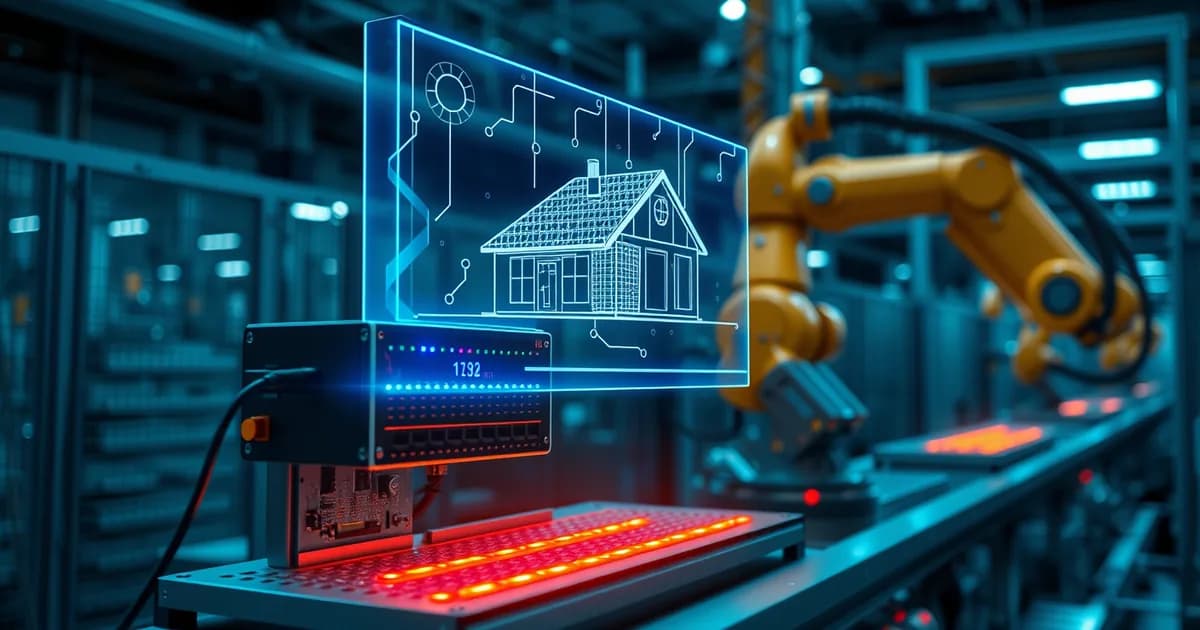
Digital twin edge AI: from offline simulation to real-time decisions
Many manufacturers have already invested in a digital twin, yet they often treat it as a static model: refreshed at intervals, hosted in the cloud and used mainly for after-the-fact analysis. The outcome is a gap between what the simulation describes and what is actually happening on the line. For a decision maker, that means choices based on a snapshot that is minutes or hours old, downtime discovered too late and a return on investment that is hard to prove.
A digital twin edge AI approach moves the centre of gravity. The twin is fed by field data and paired with AI models that run next to the machine. The research literature lists the latency of traditional cloud computing as one of the main challenges for industrial digital twins, and local processing is the remedy most often cited. The question is no longer whether to adopt a digital twin, but where its intelligence should live.
Architecture: from sensor to synchronized twin
A digital twin is a dynamic replica of an object, process or system, continuously updated with real data so that you can understand, predict and control what happens in the physical world. Achieving this in production calls for a well-designed chain, usually organized in three layers.
- Field layer: sensors, PLCs, encoders, cameras and drives producing high-frequency data streams.
- Edge layer: industrial gateways or accelerated compute modules that normalize data, run inference and keep the local twin state up to date.
- Central layer: a cloud platform or corporate data center for model training, historical data, fleet-wide analytics and coordination across plants.
The split matters: whatever needs a fast answer stays at the edge, while whatever needs heavy compute and a global view lives centrally. Raw data does not have to cross the network; the edge filters, aggregates and forwards only what is relevant, which helps with bandwidth, cost and attack surface.
Local inference: lightweight models beside the machine
Within a digital twin, AI turns a static model into an adaptive system. Supervised learning can predict failures, unsupervised learning can spot previously unknown anomalies, and reinforcement learning can support autonomous tuning of process parameters. Running these models at the edge, however, requires a few precise technical choices.
The first is compression: quantization and pruning reduce memory footprint and power draw without materially sacrificing accuracy. The second is picking a runtime optimized for the target hardware, namely the inference stack supplied by the compute module vendor, which takes advantage of dedicated accelerators to keep inference latency low. The third is the exchange format: exporting models in open formats makes it simpler to roll out the same model across several plants.
The result is a closed loop. The sensor feeds the twin, the local model evaluates the deviation from expected behavior, and the system can suggest or trigger a correction without waiting for a round trip to the cloud. What-if simulation, such as testing a new recipe or a different line speed, can also run close to the plant before the change is applied.
Synchronization, interoperability and standards
Two challenges are routinely underestimated. The first is bidirectional synchronization: the twin must receive data from the physical world but also send back commands or parameters, with rigorous handling of timestamps, event ordering and behavior when the connection drops. An edge node that keeps working autonomously during a network outage is a robustness requirement, not a luxury.
The second is interoperability across heterogeneous devices and industrial protocols. Standards help here: the ISO 23247 series, published from 2021 by ISO/TC 184/SC 4, defines a reference framework for digital twins in manufacturing, with common terminology and requirements. Using it as a design reference lowers the risk of closed solutions and eases integration between vendors.
Security deserves care too: an edge node that processes sensitive operational data locally reduces exposure to the outside, but it still needs controlled updates, device authentication and network segmentation.
Use cases: where the edge twin pays off
The most mature applications are predictive maintenance, quality control, energy management and internal supply chain optimization. In quality control, for instance, a local vision model classifies parts and updates the line twin, which can then correlate defects with process parameters. In energy management, the twin simulates load scenarios and the edge applies peak-reduction strategies.
The same pattern applies to electronic waste treatment plants, where a twin fed by computer vision can estimate the composition of incoming streams and adjust the configuration of sorting cells in real time.
Competitive advantage: twins that decide, not just describe
For a business owner or IT lead the message is clear: the value of a digital twin edge AI setup is not the visual fidelity of the model but the speed at which it turns data into action. Lower latency means less scrap, more timely interventions and the ability to experiment virtually before touching the plant. Keeping data local also strengthens security and control over process information.
The recommended path is incremental: pick a pilot line, define a few measurable indicators, adopt open standards and size the edge for the models you actually need. Companies that set up this architecture today build a reusable foundation for every future use case, and the natural next step is to dig into model compression and edge MLOps.