Orbita's Hybrid Architecture: Edge AI Meets Cloud
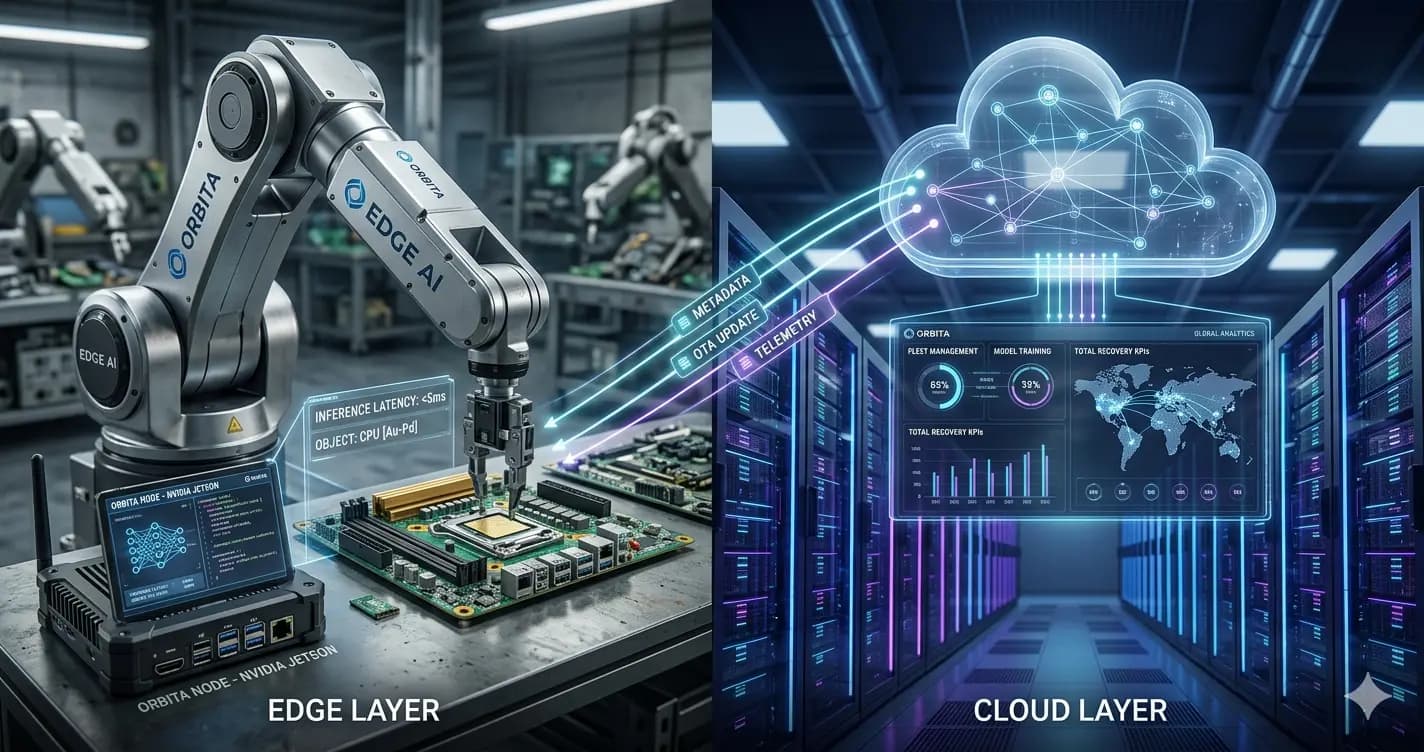
In today's industrial landscape, managing WEEE (Waste Electrical and Electronic Equipment) is no longer a purely mechanical challenge: it's a challenge of intelligent data management. For Orbita, efficiency doesn't live in a single piece of software, but in the ability to make two often-distant worlds talk to each other smoothly: the local responsiveness of the edge and the centralised governance of the cloud.
1. The architectural dilemma: why the cloud alone isn't enough
In precision automation, the critical factor is temporal determinism. A vision system that has to guide a robotic arm to extract a microprocessor from a motherboard cannot tolerate latency fluctuations.
A purely cloud-native approach, while excellent for Big Data analysis, fails on the operational floor for three fundamental reasons:
- Network latency (jitter): even a few milliseconds of delay can cause positioning errors or slowdowns on the production line.
- Bandwidth saturation: streaming high-resolution video from groups of industrial cameras to remote servers is technically and economically unsustainable.
- Single point of failure (SPOF): a brief network outage would halt the entire production line.
2. The edge layer: on-site responsiveness and computing power
Orbita addresses these issues by bringing intelligence directly to the "edge" of the network. Every operating station is equipped with compute nodes based on NVIDIA Jetson technology.
This choice makes it possible to run complex deep learning models locally. The result is a system capable of:
- Real-time inference: processing frames and classifying materials in under 10ms.
- Data sovereignty: sensitive industrial process data stays within the company perimeter, ensuring maximum security.
- Operational autonomy: the station keeps sorting correctly even with no external connectivity at all.
3. The cloud layer: orchestration, training and business intelligence
If the edge is the "arm" and the fast "reflex", the cloud is our "strategic mind". Through our centralised gateway, the cloud layer performs functions vital to the system's scalability:
- Model management and OTA updates: when our engineers optimise machine learning models, the cloud automatically distributes the new neural weights to the entire fleet deployed across sites.
- Telemetry aggregation: collecting production KPIs and material-recovery statistics to feed real-time decision dashboards.
- Centralised logging: monitoring hardware health (temperatures, CPU/GPU load) to enable predictive maintenance.
4. The convergence: Orbita's hybrid workflow
Orbita's real breakthrough lies in overcoming the precision-versus-flexibility trade-off through the synergy between distributed artificial intelligence and centralised governance.
The operational flow is circular and bidirectional:
- Ingestion: the edge captures and processes the local image.
- Action: local AI identifies the components and commands the robotic arm.
- Feedback: operation metadata is synced to the cloud for traceability.
- Evolution: the cloud analyses aggregate performance and retrains the models, closing the continuous-improvement loop.
5. Toward the autonomous microfactory
This hybrid architecture is the technological foundation of the Orbita Microfactory: compact systems that don't require massive IT infrastructure, making e-waste recovery profitable even at small scale and close to collection points. This approach drastically reduces the environmental impact of transport, delivering a genuine, local circular economy.
Solution architects and technology partners can find further detail on the MQTT and gRPC communication schemes used for edge-cloud dialogue in our technical documentation.