Computer Vision Algorithm for E-Waste Sorting
In 2025 Italy's e-waste collection rate stalled at around 32.5% of the average weight of electrical and electronic equipment placed on the market, well short of the 65% minimum threshold set by the WEEE Directive 2012/19/EU, as updated by Directive (EU) 2024/884. For treatment plants, though, the real bottleneck is rarely upstream collection: it's downstream sorting. Manually separating PCBs, technical plastics, cables and metal components takes skilled labour, time, and carries an error margin that translates into valuable material lost in the wrong fraction. This is where an e-waste sorting classification algorithm changes the equation: it doesn't replace the sorting line, it makes it observable and measurable, turning every board or component moving down the belt into a data point classified in milliseconds.
How an e-waste sorting classification algorithm works
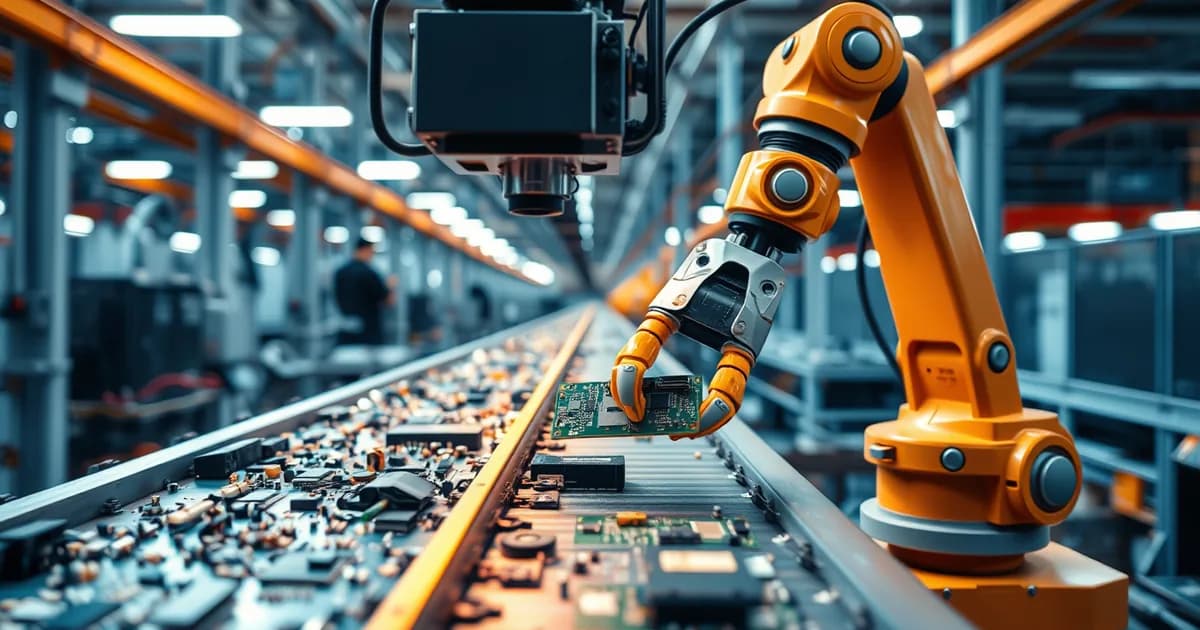
The principle mirrors machine vision systems already common in other manufacturing sectors, applied to a far more heterogeneous stream. One or more high-resolution cameras capture the material as it moves along the conveyor belt; the images are fed to a convolutional neural network (CNN) or an object-detection model from the YOLO family, trained to recognise specific material classes — circuit boards, plastic housings, metal parts, cables, glass. The output is not a simple label: for each object the model also returns its position in the frame, information a robotic arm or a compressed-air ejector then uses to physically divert the piece from the rest of the stream.
Recent academic research confirms the technology has matured: several studies report CNNs exceeding 93% accuracy classifying plastic, paper, metal and glass from mixed waste streams, while YOLO models optimised for e-waste reach comparable precision on datasets built specifically around electronic components.
Datasets, material classes and training
The quality of an e-waste sorting classification algorithm depends heavily on the training dataset. Unlike packaging plastic, e-waste shows enormous variability: smartphone models, motherboards, power supplies and small appliances change shape, colour and composition every few months. That's why the strongest projects combine proprietary datasets — captured directly on the line, with the same cameras that will later run inference — with data augmentation techniques and, increasingly, generalist segmentation models such as the Segment Anything Model (SAM) family, used to speed up labelling of the highly irregular objects typical of e-waste disassembly.
Typical classes on a treatment line include high- and low-value PCBs, ABS and polycarbonate housings, copper cabling, aluminium and steel parts, CRT and LCD display glass, and batteries. Not every misclassification costs the same: a lithium battery ending up in the wrong stream is a safety risk, not just an economic loss.
From inference to robotic pick-and-place
Once classified, an object still needs to be physically separated. Documented use cases from the recycling sector show a measurable impact from this integration: on aluminium sorting lines, introducing machine vision and robotics has lifted output purity by 8%, up to 93%, while on fibre lines the reported gain has been 12%, up to 97% purity. Dedicated robotic systems report throughput in the tens of thousands of picks per shift, with purity rates exceeding 99% on well-configured streams.
Numbers like these explain why investing in machine vision for sorting pays off less through labour-cost reduction and more through the value of the recovered material: a purer copper fraction, free of plastic or cross-metal contamination, is worth noticeably more on the secondary raw materials market.
Edge computing: why inference runs on the line, not in the cloud
A conveyor belt moving at industrial speed leaves no room for network latency: the decision — reject or route, which arm to trigger — has to land within milliseconds. That's why inference runs at the edge, directly on the line, on modules such as the NVIDIA Jetson Orin family. The high-end AGX Orin module claims up to 275 TOPS of AI compute, the Jetson Orin NX reaches up to 157 TOPS, and the more compact Orin Nano up to 67 TOPS, with power draw scaling from a few watts to a few dozen — flexibility that lets integrators size the hardware to the number of lines and cameras being served. On optimised detection models these modules sustain frame rates from 30-60 fps for YOLO-class architectures up to 200 fps on lighter models, comfortably ahead of what a typical e-waste sorting belt requires.
Local processing carries a second, often underrated advantage: it reduces dependence on continuous connectivity and keeps raw data — including any frames containing sensitive information about the products being processed — inside the plant's perimeter, simplifying the cybersecurity posture of the vision system.
Impact on traceability and compliance
An e-waste sorting classification algorithm doesn't just produce separated material: it produces data. Every classification can be logged with a timestamp, estimated weight and category, building a record useful for environmental reporting and for demonstrating, with verifiable numbers, the efficiency of the recovery process. In Italy, treatment plants operating within collective schemes such as Erion WEEE report recovering around 90% of the materials contained in e-waste — a figure machine vision helps consolidate by cutting the variability introduced by manual sorting error.
The edge that goes to whoever automates first
The technology behind automated e-waste classification — CNNs, YOLO models, edge modules like Jetson Orin — is now within reach of mid-sized plants, not just the large recycling players. Whoever deploys an e-waste sorting classification algorithm on their line first gains an advantage on two fronts at once: purer material that sells at a better price, and a granular data history that simplifies every future environmental reporting or certification request. In a market where margins on critical metal recovery hinge on a few percentage points of purity, the gap between manual sorting and vision-assisted sorting is no longer marginal — it's the line between a plant that turns a profit and one that just chases minimum compliance. It's worth working out which configuration — cameras, model, edge hardware — fits your inbound e-waste stream best.