Italy Environmental Managers Registry and WEEE: Category 5
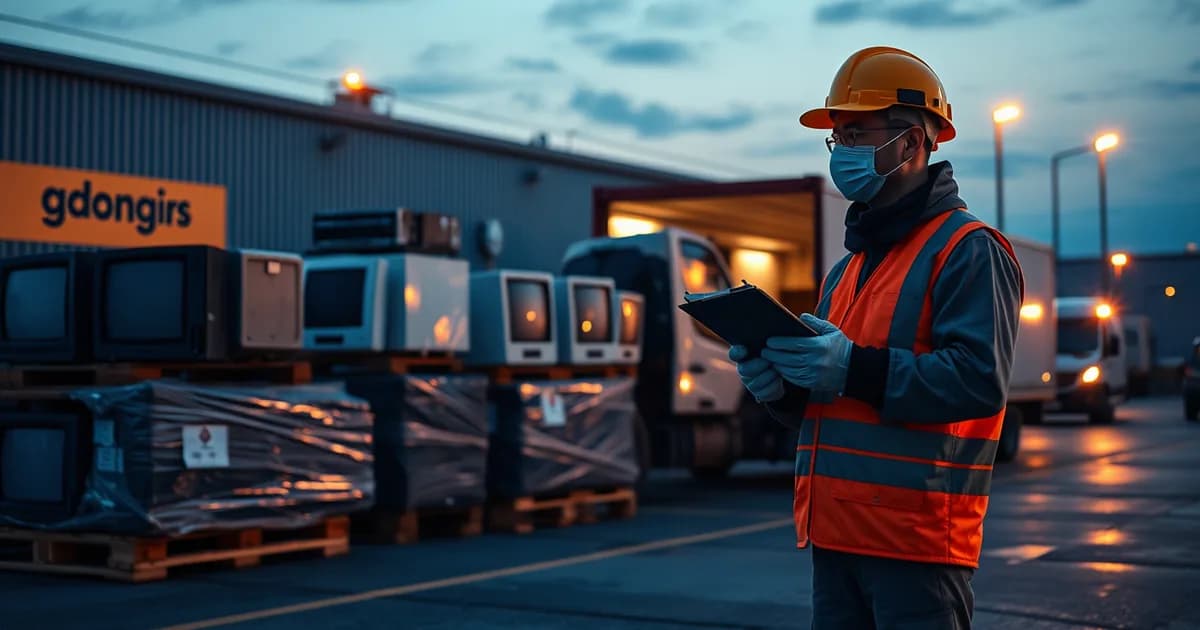
Anyone managing professional WEEE flows — end-of-life refrigerators and air conditioners, CRT monitors, fluorescent tubes, circuit boards containing hazardous components — eventually runs into a very concrete operational question: when does registration with Italy's National Register of Environmental Managers (Albo Gestori Ambientali) apply, and under which category? The answer is not uniform, because not all WEEE is classified the same way: part of it falls under non-hazardous special waste, another part under hazardous special waste, with direct consequences on requirements, financial guarantees and carrier liability. For anyone planning reverse-logistics investments or evaluating a new collection provider, understanding where Category 5 of the environmental managers registry for WEEE fits in means avoiding operational stoppages, penalties and disputes during audits.
What Category 5 of the Environmental Managers Registry authorizes
Category 5 of the National Register of Environmental Managers authorizes the collection and transport of hazardous special waste produced by third parties, as well as the transport of a company's own hazardous waste once it exceeds thresholds of 30 kg or 30 litres per day, and the handling of hazardous waste resulting from treatment operations that change its nature or composition. It is the "twin" of Category 4, which instead covers non-hazardous special waste: the distinction between the two does not depend on the type of equipment but on how the waste is classified under the relevant EER code, governed by Legislative Decree 152/2006.
Which WEEE fractions count as hazardous waste
Not all WEEE is equal from a regulatory standpoint. Refrigeration and air-conditioning equipment (containing refrigerant gases and lubricating oils), cathode-ray tubes and CRT monitors (due to lead and phosphor coatings), light sources such as fluorescent tubes (due to mercury content), and certain circuit boards with hazardous components are typically classified as hazardous waste. Professional transport of these fractions, whether on behalf of third parties or beyond the thresholds set for producers, therefore requires Category 5 registration. Non-hazardous WEEE fractions — many small household appliances, IT equipment without critical components, power tools — remain instead within the scope of Category 4.
Requirements, classes and financial guarantees
Category 5 registration requires meeting subjective eligibility criteria (no disqualifying measures or convictions against the company's principals), the appointment of a technical manager with specific training, and demonstrable financial capacity according to the framework set by the Registry's National Committee. For vehicles over 3.5 tonnes, the minimum financial provision is indicatively around 9,000 euros for the first vehicle plus an additional amount per extra vehicle; for vehicles up to 3.5 tonnes the thresholds are proportionally lower. A financial guarantee in favour of the State is also required, with the amount varying according to the registration class (classes range from A, for the highest annual volumes, to F, for the smallest quantities). Companies certified under EMAS or ISO 14001 can benefit from reductions on the required guarantee. Registration is valid for five years and must be renewed with a minimum lead time before expiry to avoid operational interruptions.
The end of Category 3-bis and the new CdC RAEE portal
A significant change for operators in the WEEE supply chain is the repeal of Category 3-bis of the Registry, introduced by the law converting decree-law 131/2024 and effective from 15 November 2024: from that date, preliminary storage and transport operations carried out by distributors — typically under "one-against-one" and "one-against-zero" take-back schemes — no longer require registration with the Environmental Managers Registry. Distributors, installers, technical assistance centres and WEEE transporters must instead register on the portal of Italy's WEEE Coordination Centre (CdC RAEE), selecting the registration code that matches their role. Registrations already active under other Registry categories remain valid and are unaffected by the repeal: companies that also transport hazardous fractions therefore still need to comply through Category 5.
Navigating between Category 4, Category 5 and CdC RAEE
For a company managing professional WEEE, the compliance map is built by cross-referencing three elements: whether the waste stream handled is hazardous or non-hazardous, the role played in the supply chain (distributor under the simplified scheme, third-party transporter, treatment plant operator), and the volumes handled annually. A company operating exclusively within the simplified CdC RAEE take-back scheme does not need Category 5; one that handles hazardous waste beyond the set thresholds — or processes significant quantities on its own account — cannot avoid registering with the environmental managers registry for WEEE under Category 5, along with the related guarantee costs and documentation obligations. Companies already registered on the CdC RAEE portal that expand their activity to also handle hazardous fractions on behalf of third parties should therefore assess Category 5 registration separately, since the two procedures serve different purposes and are not substitutes for one another.
Getting this perimeter right is not just a matter of formal compliance: it is a genuine competitive lever. A traceable recovery chain, with registrations under the environmental managers registry for WEEE that match the waste streams actually handled, is easier to verify during audits by industrial customers and control bodies, and aligns better with the circular-economy criteria that more and more decision makers now apply when selecting suppliers.